Get Full Government Meeting Transcripts, Videos, & Alerts Forever!
Get email alerts on the Homelessness And Public Safety topic
No spam. Unsubscribe anytime.
East Lancing Council adopts parking‑facility restriction but rejects camping/loitering ordinance after hours of public comment
Summary
Council approved an ordinance narrowing acceptable uses inside public parking structures to allow officers to warn and move along disruptive gatherings, while rejecting a proposed camping/loitering law after large public testimony argued it would criminalize homelessness and harm marginalized residents.
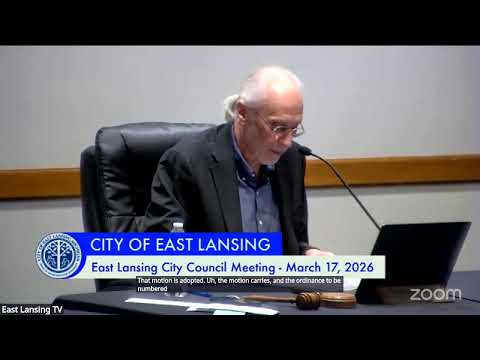
East Lancing — After more than four hours of public comment March 17, the East Lancing City Council voted 3–2 to adopt a revised ordinance restricting non‑parking uses of public parking structures and to decline proposed amendments that would have expanded camping and loitering prohibitions.
Chief Jen Brown, speaking for the downtown solutions committee, told the council the change was prompted by a spike in ramp‑related reports over the 2024–25 fall season and by repeated calls for help from community partners. The approved ordinance (alternative B of draft 1565) requires an officer to warn people engaged in non‑parking activity and authorizes a civil infraction citation if a person refuses to leave. Brown said the provision is designed as a preventive tool to allow police and outreach partners to move gatherings before they escalate into assaults, damage or increased victimization.
The measure drew sharp debate over enforcement mechanics. Supporters, including several downtown business owners and some council members, said their customers and employees had reported feeling unsafe in ramps during late‑night gatherings and that officers needed an intermediate enforcement option between informal requests and criminal arrests.
Opponents and dozens of public speakers urged the council to reject both that change and a companion ordinance (draft 1566) that would have clarified rules on camping or occupying public places. Advocates, unhoused and formerly unhoused residents, and service‑provider leaders argued that criminal penalties and misdemeanors for loitering or sleeping in certain public spaces would effectively criminalize poverty. They urged the city to invest instead in housing‑first solutions, outreach by social‑service staff, and multi‑agency coordination. Several speakers cited federal court decisions and local experience showing fines can compound vulnerability and reduce access to housing and services.
Council members split on how to balance safety and compassion. In voice and roll‑call exchanges, some members argued the city needed clear, narrowly tailored rules to keep ramps safe for everyone; others said a criminal statute risked disproportionate enforcement against people of color and the unhoused and urged the city to expand outreach and housing supports before adding new criminal penalties.
On the camping/loitering amendments (draft 1566), council ultimately voted to not adopt the proposed language and instead to keep the existing code in place while staff and council consider alternative service‑oriented responses. For the parking‑facility ordinance, Council adopted Version B (civil‑infraction path) and included language exempting emergency sheltering during severe weather and emphasizing social‑worker engagement as part of enforcement for people identified as unhoused.
City staff and advocates noted the change does not remove outreach options. Council members and staff repeatedly said enforcement should be coordinated with social‑service partners and that the city’s social‑work staff would continue to be deployed to calls involving vulnerable people.
The council’s votes followed nearly three hours of public comment focused primarily on two interlocking issues: a proposed 13‑story development at 530 Albert Avenue (which includes two levels of internal parking and a 25% diverse‑housing component) and the proposed ordinances affecting parking structures and camping/loitering. Speakers on both sides urged the council to consider impacts on safety, housing supply, neighborhood character and equity.
The parking‑facility ordinance takes effect as written; the city said it will provide training and updated guidance to officers and to the city prosecutor to ensure the warning‑first enforcement model is used as intended. The camping/loitering proposals were not adopted; council left the existing code in place and asked staff to continue engaging advocates and service providers to develop alternatives.
The council separately adopted a six‑month moratorium on new data‑center land uses in East Lancing to allow staff and experts time to draft clearer zoning rules for that product type. The meeting also included routine consent items, a large public‑comment period on housing and homelessness, and procedural votes on legal services.