Get Full Government Meeting Transcripts, Videos, & Alerts Forever!
Get email alerts on the 009 Funds Policy topic
No spam. Unsubscribe anytime.
Mason County stakeholders press commissioners for clearer 0.09 funding rules, urge larger awards and geographic flexibility
Summary
Stakeholders urged the Board of County Commissioners to set a transparent annual process for distributing 0.09 funds, recommend larger baseline awards for multi‑million‑dollar infrastructure projects, and preserve the BOCC's final authorization while using outside scoring and yearly funding limits.
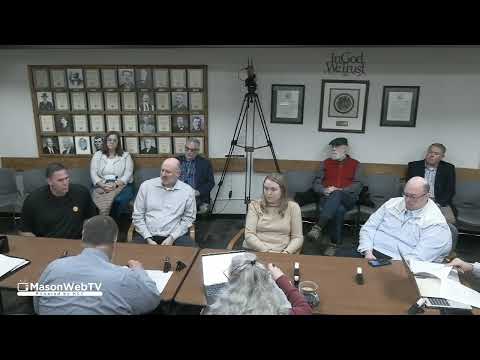
Travis, a county staff member who drafted the proposed procedure, opened the stakeholders meeting by saying the goal was to create a clear, consistent process for administering the county’s 0.09 funds and that he approached the draft neutrally: "I'm, as far as I'm concerned, sort of Switzerland on the document," he said.
Why it matters: Commissioners and stakeholders disagreed over how to balance smaller, frequent awards with larger, multi‑year infrastructure commitments that often require significant local match. With about $4.15 million in the fund and roughly $1.26 million projected in 2026 revenue, participants said a predictable process could help agencies plan and leverage other state and federal dollars.
Members of the economic development community urged the BOCC to set a process that is clear and predictable. "We're a beneficiary of the '09 fund; that's the contracted work we do with the county," said Kevin Shudy of the Economic Development Council. He recommended the county announce available dollars and timeline at the outset of each funding round so agencies can coordinate applications with other grant opportunities.
Public-utility and municipal leaders pushed for larger standard awards and flexible multi‑year funding. "For projects that actually move the needle for economic development, those projects cost much more than that," said Justin Hollesgroveve of PUD3, arguing that a standard project threshold should start at $250,000 and that multi‑year projects should be built into the standard process. Kristen Meller of Mason County PUD No. 1 cautioned against confining awards solely to urban growth areas, saying water and electrical infrastructure outside growth boundaries can also enable housing and economic development.
The City of Shelton provided a concrete example of scale: city manager Mark Ziggler described a planned sewer extension tied to an 80‑plus unit multifamily development and said nearly $2 million in additional funding would be needed beyond design costs to advance construction.
Commissioner concerns centered on prioritization and stewardship. One commissioner warned that delegating too much of the scoring process could allow larger projects to "eat the small" and said the BOCC must retain discretion to weigh projects and preserve funds for strategic opportunities that require larger commitments. Commissioners discussed a hybrid approach: allow an outside panel to score and vet applications, but require applicants to present to the BOCC, which would retain final authorization and discretion to divert funding where county priorities or knowledge warrant.
Finance staff (Jen) told the group the fund began the year with approximately $4,154,488 and projected roughly $1,260,000 in 2026 revenue; current appropriations total about $730,000 including an EDC allocation and several sequenced sewer payments. Commissioners noted that while ARPA-era distributions had been large, the 0.09 pool is smaller and will require careful stewardship.
Next steps: Commissioners asked staff to incorporate stakeholder feedback on award thresholds, geographic considerations, and scoring/authorization mechanics and to return for further discussion next week before formalizing policy language.