Get Full Government Meeting Transcripts, Videos, & Alerts Forever!
Get email alerts on the Zoning And Code Cleanup topic
No spam. Unsubscribe anytime.
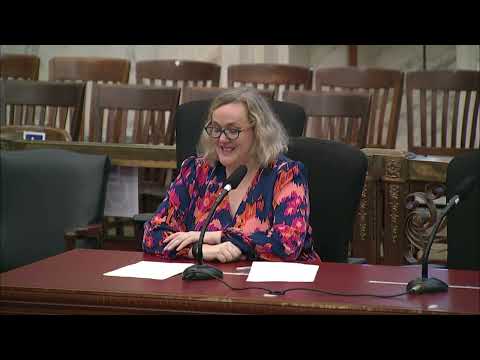
Philadelphia rules committee advances four zoning and code‑cleanup ordinances after testimony from planning and L&I staff
Summary
The Committee on Rules heard testimony from the City Planning Commission and the Department of Licenses & Inspections on four ordinances — rezoning near the Whisten transit center, removal of expired overlay language, deletion of pandemic-era sidewalk-cafe entertainment provisions, and a Sixth District overlay with height limits — adopted two technical amendments, and reported the bills with a favorable recommendation and a motion to suspend the rules for first reading at the next council session.
The Philadelphia City Council Committee on Rules on Feb. 19, 2026 advanced four ordinances after staff testimony and brief member questions, adopting two technical amendments and voting to report the measures to council with a favorable recommendation.
Paula Brumblo Burns, director of legislation for the Philadelphia City Planning Commission, told the committee that bill 260022 would rezone the newly constructed Whisten transit center and immediately adjacent parcels in the Manunk neighborhood from I1 (light industrial) to ICMX (industrial‑commercial mixed‑use), and that the change would apply only to the transfer center parcel to allow uses that complement the transit hub. She said the change is consistent with the Lower Northwest district and Whisten Gateway plans and that the Planning Commission recommended approval with amendments.
In separate testimony on bill 260055, Brumblo Burns said the measure removes an expired Warrington Affordable Housing overlay provision (14‑522) created in 2023 to grant zoning relief for a low‑income housing tax credit project at 50th Street and Warrington Avenue; the overlay’s sunset date has passed and applicants have already obtained zoning permits, so the bill is a code cleanup and was recommended for approval by the Planning Commission.
Sarah Adamo, director of zoning and legislation for the Department of Licenses and Inspections Quality of Life unit, described bill 260073 as a routine cleanup that would remove pandemic‑era, sunsetted language that allowed outdoor entertainment at sidewalk cafes, streetery operations, and certain sidewalk closures (originally enacted with a December 31, 2021 sunset). Council Member Gilmore Richardson said she participated in the original package and expressed support for removing expired language; Council Member O’Neal asked how often L&I performs code cleanups and was told the work is ongoing and typically done when sections are revised.
Brumblo Burns also testified on bill 260074, which creates a new SIX (Sixth District) overlay by reorganizing several overlays within the Sixth Councilmatic District, transfers provisions from the existing Northeast overlay and the IMA (Industrial and Manufacturing Area) overlay into the new SIX overlay, and adds a provision limiting maximum building heights in RSA5 residential single‑family attached zoning to preserve the contextual rowhouse scale in parts of northeast Philadelphia. When members asked whether the measure raises or lowers height limits, Brumblo Burns clarified that the overlay is intended to preserve existing contextual heights (for example, three‑story rows remain three stories).
On the committee floor, Council Member Skilla offered and moved adoption of technical amendments to bill 260022 and to bill 260074; both amendments were seconded and adopted by voice vote. Skilla then moved that bills 260022 (as amended), 260055, 260073, and 260074 (as amended) be reported from committee with a favorable recommendation and that the rules be suspended to permit first reading of the measures at the next council session. The motion was seconded and passed by voice vote.
No members of the public registered to testify during the hearing. The committee concluded its business and adjourned.
What happens next: The bills were reported out of the Committee on Rules with a favorable recommendation and, pending the scheduled first reading under the suspended rules, will appear on the next City Council session agenda for first reading.