Get Full Government Meeting Transcripts, Videos, & Alerts Forever!
Get email alerts on the School Facilities topic
No spam. Unsubscribe anytime.
Cranston school leaders describe failing boilers and leaking roofs, urge a repair bond; immediate ask $31.9M
Summary
Superintendent Janine Nadamasi and facilities staff told a joint council/school committee meeting that school boilers, roofs and electrical systems are failing across the district and outlined an immediate $31.9 million package for roofs and HVAC repairs; officials discussed fast‑tracking RIDE paperwork for a potential November bond and weighed larger, multi‑year plans.
Cranston — In a joint City Council and School Committee meeting on March 4, Superintendent Janine Nadamasi and the district’s facilities staff presented a franchise‑wide facilities assessment and urged the city to consider a near‑term repair‑and‑renovation bond.
Nadamasi told the joint session that some classrooms faced frigid temperatures when boilers failed, while other spaces ran unusually hot — “on any given day, I worry about a catastrophic failure of one of our buildings,” she said, asking both bodies to act sooner than the 2028 bond timeline previously discussed.
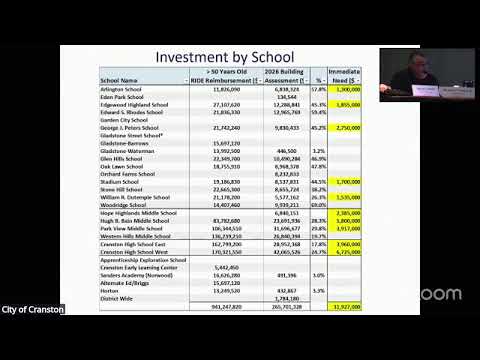
Facilities chief Christian Jeden presented a line‑item assessment: 21 of the district’s 27 schools are more than 50 years old, the portfolio totals about 1.8 million square feet, and immediate needs are concentrated in roofs and HVAC. Jeden outlined school‑level estimates (examples: Due Temple roof ~$1.935M; Arlington roof ~$1.3M; Peters roof ~$2.75M) and said the immediate roof+HVAC work the district identified totals about $31.9 million. He presented a larger facilities estimate (all categories) around $265 million (present value) and noted those figures exclude certain west‑envelope façade costs.
Nadamasi and Jeden said they have submitted preliminary paperwork to RIDE (the Rhode Island Department of Education) so the city could move quickly if it decides to seek a bond on the November ballot; presenters cautioned that state reimbursement has fallen from earlier levels — historically as high as ~74% during a prior funding window, now near ~54% — and that project estimates are budgetary and likely to escalate between planning and construction.
Council members and school committee members asked operational and procedural questions: which projects must be prioritized, how contingency and escalation will be handled, whether a five‑year master plan should guide sequential bond asks, and where students would be housed if a large building (e.g., a high school) becomes unusable. School leaders said smaller displacements have been managed quickly, but a catastrophic loss of a large high school would have no ready swing space in‑district and could force prolonged remote instruction or complex temporary relocations.
The meeting closed with general agreement to continue collaboration between the council and school committee and to refine project lists, escalation assumptions and a timetable for a possible November bond. Union leadership participating in online public comment urged immediate repairs at several schools in addition to long‑term financing.