Get Full Government Meeting Transcripts, Videos, & Alerts Forever!
Get email alerts on the Court Calendar topic
No spam. Unsubscribe anytime.
Clayton County State Court clears calendar with dozens of pleas, bench-warrant actions and a large school-bus camera docket
Summary
Judge Tammy Long Hayward presided over a virtual calendar call on March 9, 2026, during which the court accepted multiple negotiated pleas (including first-offender dispositions), recorded bench-warrant and bond-forfeiture actions, processed SSD/payment matters, and ran a large red-light/school-bus camera calendar with several appeals granted and many payment extensions.
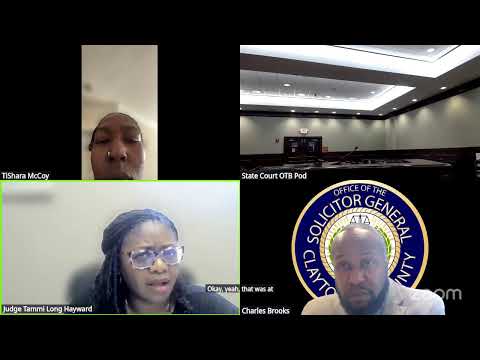
Judge Tammy Long Hayward opened a virtual calendar call for Clayton County State Court on March 9, 2026, and moved through multiple dockets — arraignments and pleas, the SSD (payment) calendar, a bond-forfeiture schedule and a heavy red-light/school-bus camera docket.
The court accepted a series of negotiated pleas and first-offender dispositions. The state recommended and the court accepted concurrent First Offender dispositions for Richard Emerson Nay on two airport-related counts; the judge sentenced both cases to 12 months with short serve terms (21 and 13 days) and suspended the balance conditioned on staying off Hartsfield–Jackson Atlanta International Airport without valid business. The court likewise accepted a First Offender plea for Ashley G. Swan (2021 CR06899) and for Derek Lee Batty (2022 CR00147); Swan received 12 months probation, a theft-prevention course and 30 hours of community service under the negotiated recommendation, while Batty received 12 months probation, a theft-prevention course, 40 hours of community service and a no‑trespass condition for the Little Giant Farmers Market in Riverdale.
Other pleas resolved during the session included Bree T. Tanner, who entered no-contest pleas to amended disorderly conduct counts in two cases and was sentenced to 12 months probation and a combined 60 hours of community service with a no-contact restriction; Nathaniel Taji Streeter and Maris Lamont Johnson each entered reduced pleas stemming from DUI-related matters and were placed on probation with community-service and substance‑abuse conditions. In each probation case the court ordered an intake with the probation officer to register reporting requirements and to explain random screening and paperwork.
The judge repeatedly emphasized the practical requirement of probation reporting: “Now, the quickest way to get rearrested is to not um uh show up for your probation reports,” Hayward told defendants during intake scheduling, explaining how to arrange mail reporting and submit proof of course completion.
Procedural conferences were common: judges and attorneys used Zoom breakout rooms for side-bar plea negotiations and to allow defendants and counsel to confer with the state. Several attorneys raised discovery concerns on the record and asked for resets where discovery had not been provided; the court allowed targeted resets when prosecutors had not produced digital media or when attorneys had newly substituted into matters.
The SSD/payment calendar addressed low-dollar traffic cases and fines that had gone unpaid after earlier notices. The judge gave modest extensions for many defendants but warned that repeated failures to pay after notice could lead to arrest warrants; the court instructed people to submit verified email addresses to the clerk so staff could issue payment modifications.
On the bond-forfeiture calendar the prosecutor asked for and the court granted multiple rule-absolute orders where defendants had not appeared; the docket also flagged several wanted defendants or incarcerated individuals for follow-up and noted requests to transfer certain jail-altercation cases to superior court.
The day’s largest single docket was the red-light and school-bus camera calendar. Hayward explained the contest process and the affidavit required to name a different driver; when an affidavit showing a different driver or ownership history was received, the court frequently granted the appeal. The judge also reminded the public that passing a stopped school bus carries a state-set penalty (statute-driven) and can be as much as $1,000, and urged drivers to stop whenever school-bus signals are activated unless there is a physical, impassable median.
In one in-court review, the court viewed a short camera clip connected to a school-zone speeding citation. The system recorded a 48‑mph reading in a 25‑mph school zone; the judge offered and the defendant accepted a reduction to a $70 disposition and was directed to pay at the traffic window at the courthouse.
What’s next: the judge signed orders and directed probation intakes for those placed on supervision; several trial-ready announcements were set for the March 23 trial calendar. Clerks were asked to issue mailed notices where the court had granted payment or reset orders. The court closed the calendars and reminded attendees to use full names on Zoom and to follow probation reporting instructions.
Key outcomes at a glance: several First Offender pleas accepted (including Derek Lee Batty and Ashley Swan); multiple negotiated pleas and probation dispositions (Tanner, Streeter, Johnson); numerous rule-absolute/bond-forfeiture rulings for non-appearing defendants; SSD payment extensions and several 60–90 day payment allowances on red-light/school-bus citations; ongoing discovery-driven resets and multiple breakout-room conferences for plea negotiation.
The court’s transcript and a set of signed orders will supply case-specific sentencing language and exact fine amounts for inclusion in case files and clerk records.