Get Full Government Meeting Transcripts, Videos, & Alerts Forever!
Get email alerts on the Zoning And Business License Changes topic
No spam. Unsubscribe anytime.
Wyoming council approves zoning changes and streamlines mobile food-vendor licensing
Summary
The City Council passed several zoning and licensing reforms aimed at reducing nonconforming lots in residential districts and easing mobile food vendor requirements; the package passed unanimously on final reading and will make renovations and some business activities easier under local code.
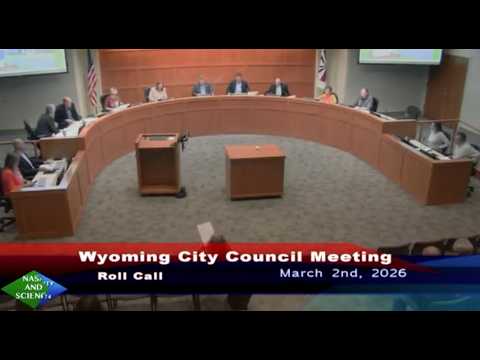
The City Council of the City of Wyoming on a unanimous vote adopted a set of ordinances intended to reduce zoning nonconformities and simplify small-business licensing.
The council passed Ordinance 3-26 on final reading to remove the separate general business-license requirement for mobile food vendors, leaving vendors subject to the food‑vendor licensing requirements only. Staff said the change eliminates duplicative licensing steps for mobile operators.
Councilors also adopted zoning amendments under Ordinance 4-26 to revise R-2 rules—adjusting minimum lot sizes, lot widths, setbacks and house-size regulations—to bring roughly two-thirds of existing R‑2 parcels closer to conformity and make it easier for homeowners to renovate or add on without triggering nonconforming‑use complications. Separately, Ordinance 5-26 rezones parcels currently in R‑3 to R‑2 for similar reasons; staff said the rezoning is intended to ease future renovations and does not force property owners to act.
All final‑reading votes reported in the meeting record were taken by roll call and were recorded as affirmative across the council: Brethauer, DeKryger, Hill, Postema, Postler and the Mayor Pro Tem voted yes. Council discussion emphasized reducing regulatory barriers for homeowners and aligning code across districts.
The council also held first readings on two related code updates: Ordinance 6‑26, which would tighten rules and increase fines for unauthorized hydrant use and require metering/backflow protections for contractors, and Ordinance 7‑26, which would modernize definitions and allow varying levels of animal daycare, boarding and kennel uses in appropriate zoning districts. Those items were introduced for future consideration.
What happens next: Final administrative implementation dates and any permitting details will be set following ordinance publication and standard administrative processing. Staff said affected property owners who do not want to pursue changes will be unaffected unless they opt in.
Votes at a glance: Ordinance 3‑26 (mobile food vendor licensing) — passed (unanimous). Ordinance 4‑26 (R‑2 amendments) — passed (unanimous). Ordinance 5‑26 (rezone R‑3 to R‑2) — passed (unanimous). Ordinances 6‑26 and 7‑26 were introduced (first reading) and will return for further action.