Get Full Government Meeting Transcripts, Videos, & Alerts Forever!
Get email alerts on the Economic Development topic
No spam. Unsubscribe anytime.
Wyoming council considers layered abatements and brownfield TIF to attract manufacturing employer
Summary
City staff proposed layering a Plant Rehabilitation District, an Industrial Development Exemption and a brownfield TIF to support Leading Manufacturing’s move to a vacant Wyoming facility, projecting about 66 jobs and roughly $11.9–$12 million in investment; council asked for detailed fiscal-impact numbers before approving incentives.
City staff on March 9 outlined a package of tax incentives and a brownfield tax-increment financing (TIF) plan to support Leading Manufacturing’s proposed relocation from Grand Rapids to a vacant 175,000-square-foot facility in Wyoming.
The proposal would combine a Plant Rehabilitation District (PRD) to freeze plant-and-machinery value on the existing structure, an Industrial Development Exemption (IDE) that would reduce taxes on about 30,000 square feet of new construction (staff said roughly a 50% reduction on the addition), and a 30-year brownfield plan with a 70/30 developer/jurisdiction split for eligible cleanup reimbursements. Staff said the company expects to invest about $11.9–$12 million and bring 66 positions to the city, which meets the thresholds in the city’s tax-abatement policy enacted in June 2024 for a 12-year abatement term.
Why it matters: Staff said the site has long-standing infrastructure and contamination challenges and has sat vacant since Graphic Packaging International closed in 2024, eliminating 111 jobs. The layered approach is designed to make the project economically feasible by reducing upfront tax costs and reimbursing environmental cleanup to return the property to productive use.
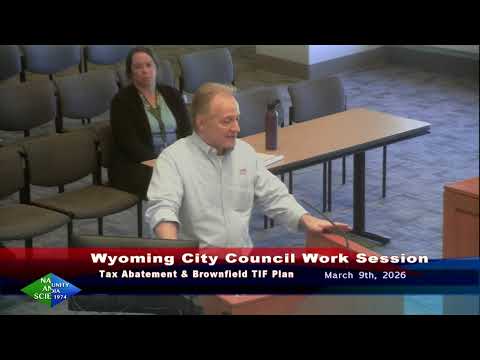
Owner Steven Traynor described the facility’s age and deferred maintenance and said the company needs municipal assistance to make the numbers work. “We absolutely really need the help,” Traynor said, stressing the company’s 20-year modernization track record and plans to transfer most of its workforce to Wyoming.
Staff emphasized the public-benefit criteria in Wyoming’s tax-abatement policy, noting that the project’s projected investment and job counts meet the policy’s top tier and would qualify for the maximum 12-year term for both the PRD (rehab) and IDE (new construction). Staff also summarized brownfield estimates, saying EGLE-eligible site assessment and cleanup activities total just shy of $1 million and other eligible costs (demolition/asbestos removal) are roughly $1.3 million; those figures inform the brownfield reimbursement request.
Council reaction focused on fiscal detail. Councilmember Rob asked for present-value comparisons and a year-by-year spreadsheet showing tax capture under the PRD/IDE layering and the brownfield TIF versus a demolition or no-action scenario. Staff said those detailed calculations were not prepared for the work session but agreed to provide a spreadsheet showing the expected capture during the abatement years and what the jurisdiction’s share would look like after the abatements expire.
On liability, a council member asked whether current companies can be held accountable for historic contamination. Staff answered that regulatory enforcement (EGLE and potentially identification of potentially responsible parties) can occur when liable parties exist, but many brownfield sites have no viable PRPs, which is precisely why brownfield reimbursement can enable redevelopment by a new owner.
Next steps: Staff said a public hearing to consider the PRD and IDE is scheduled for March 16; the Wyoming Brownfield Redevelopment Authority will consider the brownfield plan later in March, and the brownfield plan and related agreements would return to council in April for further action. No final council vote or formal agreement was approved during the March 9 work session.
Authorities and agreements referenced in the presentation — the city’s tax abatement policy (adopted June 2024), the proposed PRD/IDE mechanics, and the brownfield TIF plan — would be formalized through future hearings and developer agreements that include retention terms and anti-appeal clauses.