Get Full Government Meeting Transcripts, Videos, & Alerts Forever!
Get email alerts on the Afghanistan Unama Mandate topic
No spam. Unsubscribe anytime.
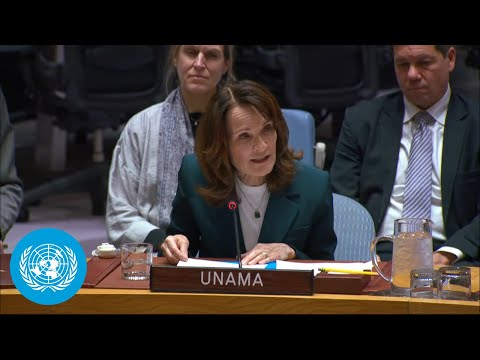
Miss Geette Gagnel urges council to back UNAMA engagement, warns Afghanistan's isolation risks regional instability
Summary
Miss Geette Gagnel briefed the council on Afghanistan, urging support for UNAMA's political engagement and immediate humanitarian access. She warned that Afghanistan’s estrangement from the international system—compounded by border conflict, restrictions on women and low humanitarian funding—risks wider regional instability.
Miss Geette Gagnel addressed the council during consideration of agenda item two, urging member states to support the United Nations Assistance Mission in Afghanistan (UNAMA) and warning that Afghanistan's continued isolation is amplifying humanitarian and security risks.
"Afghanistan's continued alienation from the international system remains the central issue," Gagnel said, adding that isolation prevents progress on economic self‑sufficiency, security cooperation, counterterrorism and human rights.
She described UNAMA's political engagement through the Doha process, saying it aims to create conditions for reintegration while keeping the rights and aspirations of the Afghan people "front and center." Gagnel referenced the November 2023 independent assessment that recommended advancing a political pathway and said the mission has maintained channels for constructive engagement.
Gagnel cited concrete pressures: closures on the Afghanistan–Pakistan border and uncertainty on alternative routes through Iran have driven up commodity prices and strained the fragile economy. She warned that continued instability could drive "out migration, terrorism, narcotics, and more."
On counter‑narcotics, she noted the de facto authorities' ban on opium poppy cultivation has been maintained and cited UNODC survey results showing about 10,200 hectares under cultivation in 2025, roughly 20% lower than in 2024 and a small fraction of pre‑ban levels. "More support from the international community is needed to maintain the gains made on counter narcotics," she said.
Gagnel also highlighted social pressures: Afghanistan has absorbed about 5.5 million people returning from neighboring countries since September 2023, she said, and major urban centers are stretched beyond capacity as international assistance declines.
She pressed de facto authorities on gendered restrictions, saying policies that exclude women from public life and education past grade six "are now entering their fifth year of almost total exclusion" and will deplete the country's human capital. "The restrictions on women working in the humanitarian sector is one clear example," she said, arguing the measures reduce the UN's ability to reach Afghan women.
Gagnel warned of a recent six‑month ban that has prevented UN female national personnel from reporting for duty at their places of work, calling it a breach of privileges and immunities and urging the authorities to lift the restrictions to restore UN capacity.
She criticized decree number 12 on criminal rules as discriminatory toward women and religious minorities and said its vague wording "opens the potential for misinterpretation and abuse."
On security, Gagnel said de facto authorities have shown limited progress on counterterrorism commitments. She recounted an active border conflict with Pakistan, including air strikes in Afghan cities, and noted continuing international concern about groups affiliated with or operating from Afghanistan, including references to the TTP and ISIL‑K.
Looking ahead, Gagnel said humanitarian partners plan to reach 17.5 million Afghans in 2026 through an appeal of $1.71 billion and that the appeal is only about 10% funded. She urged the council and member states to maintain attention and incentives for reintegration and said she looked forward to renewal of UNAMA's mandate next week.
The chair thanked Miss Geette Gagnel for her briefing; no formal vote or motion on the floor was recorded during the exchange.