Get Full Government Meeting Transcripts, Videos, & Alerts Forever!
Get email alerts on the Municipal Budget topic
No spam. Unsubscribe anytime.
Mayor presents FY2027 budget with $133.6 million in net reductions; administration pledges no tax-rate increase
Summary
Mayor Rick Blangiardi and Budget Director Andy Kawano presented the FY2027 executive operating and CIP budgets, describing $133.6 million in net reductions, a flat property-tax revenue outlook, vacancy-driven cuts, and a prioritization of finishable CIP projects and essential fixed costs.
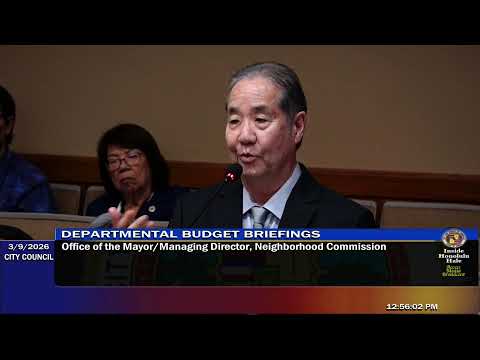
Mayor Rick Blangiardi and Director Andy Kawano presented Honolulu’s FY2027 executive operating and capital budgets on March 9, 2026, telling the Council the administration trimmed the mayor’s initial balancing target and arrived at $133.6 million in net budget reductions.
In prepared remarks, the mayor framed the package as a disciplined effort to "do more with less," citing household cost pressures and a limited near-term revenue outlook. Director Andy Kawano said the city’s main revenue source — real property tax — is expected to be essentially flat for several years and that roughly 80% of the operating budget is committed to fixed costs such as employee benefits, debt service, public safety, mass transit and sanitation.
Kawano outlined the administration’s approach to balancing the budget: a department-by-department review of vacancies and lapsed salary dollars; reallocations of salary lines toward higher-priority services; a roughly $30 million reduction from salary budgets via vacancy savings; and modest reductions in benefit provisions and provisional accounts. He noted the city has an unreserved general fund balance that provides temporary flexibility but warned it cannot substitute for structural balance over time.
The presentation also described a $172.1 million decrease to the six-year CIP (to $1.11 billion), with the administration prioritizing projects that can be started and finished within the mayor’s remaining term and those required by law or tied to public-safety risks.
On taxation, Councilmembers asked whether the administration included any tax relief to lower residents’ burdens. Kawano said the mayor committed not to raise tax rates and that earlier actions expanded homeowner exemptions; the administration considered—but declined at this time—to reduce tax rates because doing so would risk service levels. Kawano said the city’s fiscal stability fund will receive a planned $5 million transfer in FY27; the administration estimates about $200 million could be in the fiscal stability fund by June 30, 2026.
Members pressed for department-level detail about vacancy cuts after Kawano said some departments bore larger shares of reductions (HPD, DFM, DPR were cited as examples). Kawano described the methodology used to set cuts — historic lapse rates, vacancy trends, operational necessity and bargaining agreements — and said the administration notified departments in January when balancing targets crystallized.
Kawano and members also discussed pension funding and ERS contributions. Kawano said the city’s ERS allocation is large and that the city is about 65% funded on an allocated basis; he warned that easing contributions would increase long-term liabilities and potentially affect borrowing costs.
The mayor and director emphasized the administration’s intent to protect essential services while narrowing discretionary spending and to pursue federal and external funding where possible. The committee set further departmental briefings and follow-up requests for more granular line-item detail.
The committee moved on to additional departmental presentations and did not take formal action on the budget during the March 9 session.