Get Full Government Meeting Transcripts, Videos, & Alerts Forever!
Get email alerts on the Public Safety topic
No spam. Unsubscribe anytime.
Prosecutor seeks 20 deputies and $2.3M to reduce caseloads amid surge in felony filings
Summary
Prosecuting Attorney Alm asked the committee to approve up to 20 additional deputy prosecutor positions (estimated $2.317M) to reduce high caseloads and manage a 69% increase in felony filings over two years; the office said hiring pipelines from law‑school interns make rapid staffing possible if positions are funded.
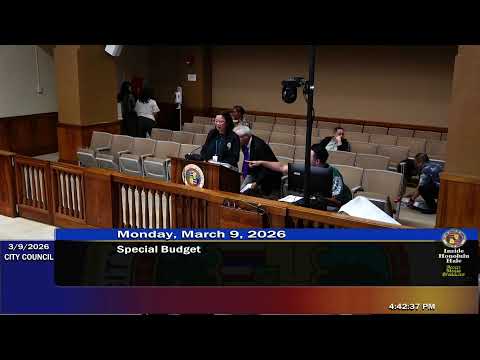
Prosecuting Attorney Alm told the Committee on Budget and Fiscal Services that the Prosecuting Attorney's Office (PAO) needs substantial additional staffing to keep pace with rising felony filings and the labor‑intensive review of body‑worn camera evidence.
Alm said the office has seen a dramatic increase in filings — 69% for felonies across two years — and that the average felony caseload per deputy remains high (roughly 50 active cases) compared with a desired target near 30. "An average felony caseload is 50 active cases. We’d like to get that down to about 30," the office stated in the briefing and slide deck.
To address the workload, PAO requested 20 additional deputy prosecutor positions at an estimated cost of $2,317,680 (roughly $115,000 per position at starting salary), plus related support hires such as paralegals and an audio‑visual specialist for courtroom and body‑worn camera evidence management. Alm highlighted strong applicant pools and an internship pipeline from the University of Hawai‘i law school as evidence the office can fill positions quickly if funded.
Why it matters: The PAO said delays in screening intake and evidence review create downstream effects: cases can sit in a first‑in/first‑out queue for months before a deputy can review them, which can slow diversion, probation screenings and timely prosecution. Alm and staff argued that more front‑line screening capacity would speed case processing and help prevent reoffending by earlier intervention.
Budget tradeoffs and next steps: Council members recognized public‑safety gain potential but noted a $2.3 million ask is large relative to constrained city resources. PAO said it would work with the Mayor’s administration and BFS to find savings where possible and expects the council amendment process to determine what can be funded.
Ending: Alm reiterated that PAO would continue recruiting conditionally (offers to candidates subject to position availability) and pursue funding options; the committee requested additional detail on which positions could be phased and the projected timeline to fill hires.