Get Full Government Meeting Transcripts, Videos, & Alerts Forever!
Get email alerts on the Traffic Safety topic
No spam. Unsubscribe anytime.
Belmont adopts Vision Zero traffic-safety action plan, pledges to eliminate traffic deaths by 2030
Summary
Belmont City Council unanimously adopted the Vision Zero Belmont Traffic Safety Action Plan, directing staff to publish the plan, pursue low-cost pilots, and seek grants for permanent improvements to reduce fatalities and severe injuries on city streets.
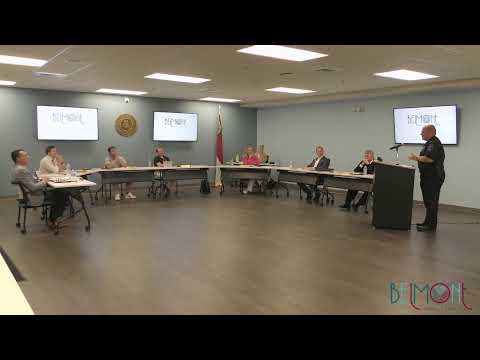
Belmont City Council unanimously adopted the Vision Zero Belmont Traffic Safety Action Plan on Oct. 21, directing staff to publish the plan, pursue pilot projects and seek grant funding to reduce traffic fatalities and severe injuries by 2030.
The plan, introduced by Captain Black and planner Reagan Murphy, frames Belmont’s approach around data-driven priorities, equity, and collaboration with regional partners. Murphy said the analysis reviewed crashes from June 2019 through May 2024 and found just over 3,100 crashes in the community during that period, with 11 fatalities and 21 serious crashes. "When a pedestrian is hit by a vehicle traveling at 20 mph, nine out of 10 potentially have a chance of surviving; at higher speeds those odds drop sharply," Captain Black said, underscoring the plan’s emphasis on speed management.
Why it matters: presenters told the council Belmont’s fatality rate over the five-year window is higher than several peer municipalities in the Charlotte region, and that most pedestrian crashes and the most severe collisions clustered on state-owned (NCDOT) roads and in lower-income census block groups. The plan establishes a High-Injury Network of the top 15 corridors and 15 intersections to prioritize safety investments.
The action plan pairs an engineering toolkit of more than 30 temporary and permanent countermeasures (for example, pedestrian refuge islands and protected bike lanes) with enforcement, education, and evaluation strategies. Staff highlighted both near-term, lower-cost pilot measures — including temporary paint-and-bollard treatments — and opportunities tied to already-funded capital projects such as improvements at the Wilkinson Boulevard/Kataba Street intersection.
Council discussion centered on coordination with the North Carolina Department of Transportation for state-owned corridors and on how crash analysis can be integrated into traffic impact analyses (TIAs) for new development. Murphy said staff will explore code updates and procedures to incorporate crash-severity measures where permissible in development review.
The motion to adopt the plan was made by Alex and seconded by Jason and passed unanimously. The council instructed staff to publish the action plan, pursue pilot deployments over the next year, and report annually on progress. The record of the vote in the transcript indicates unanimous approval; the transcript did not record an exact numeric tally.