Get Full Government Meeting Transcripts, Videos, & Alerts Forever!
Get email alerts on the Zoning Reform topic
No spam. Unsubscribe anytime.
Planning staff propose consolidated zoning "use table" and clarify group‑living rules
Summary
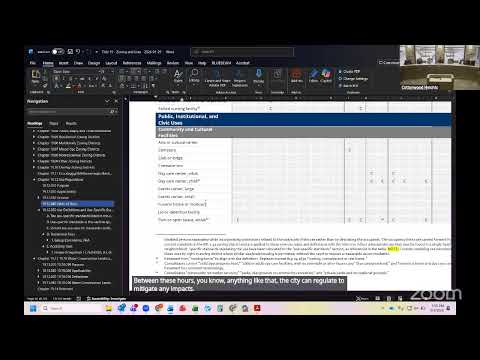
Planning staff presented a draft consolidation of Cottonwood Heights’ zoning use table to centralize permitted and conditional uses, clean up inconsistent terminology and align group‑living categories with the federal Fair Housing Act; staff said the draft will return with footnotes and later go to the City Council.
Cottonwood Heights planning staff presented on March 4 a code update project that would consolidate the city’s zoning use table, unify definitions and clarify which activities require a conditional use permit versus those that can be permitted administratively.
The proposal aims to extract use lists from each district and place them in a single table with consistent language and definitions, reducing cases where some commercial zones currently list no permitted uses and forcing routine businesses into conditional‑use review.
“Right now we’ve got all these zoning districts and you’ve got to click on each one to really know what’s permitted, what’s conditional. There’s just kind of a spelled‑out list,” the planner explained. Staff flagged an oddity in the current code that can force routine commercial operations to seek conditional approval: “If someone wants to open a retail store or a dentist office … we probably shouldn't make them come to the planning commission to get an approval.”
As part of the rewrite, staff said they are categorizing uses (residential, commercial, community/cultural, group living) and adding definitions for terms that currently appear inconsistently across the code. One focus is aligning the city’s rules with the federal Fair Housing Act when regulating residences for people with disabilities: staff proposed two size‑based categories — a group care home for one to five residents and a larger group care home for six to ten residents — because federal law limits municipalities’ ability to treat disabled occupants differently than families.
“The intent and the purpose of the federal law is if you allow any type of a residential building for a family in one place, you have to allow any disabled person to live in that same area,” staff said, noting case law and federal standards guide how local code can distinguish uses by scale but not by occupant characteristics.
Staff also proposed using objective standards to allow certain uses by right while mitigating impacts (off‑street parking, hours of operation, pick‑up/drop‑off rules) so fewer routine matters require discretionary review. The planner said staff will mark every change with footnotes so commissioners and the City Council can see where language or permissions would change.
Next steps: staff will continue drafting the consolidated table and associated definitions, circulate a formal draft with footnotes on how current permissions would shift, and schedule council review after the commission provides input.