Get Full Government Meeting Transcripts, Videos, & Alerts Forever!
Get email alerts on the Emergency Management topic
No spam. Unsubscribe anytime.
Marshall Public Schools outlines updated emergency-management procedures and new safety technology
Summary
Trisha, who leads the district's Emergency Management Team, told the school board the district has modernized its operating procedures, adopted a tiered 'standard response protocol' (moving from blanket lockdowns to targeted 'holds'), and rolled out Raptor, Crisis Go and a Geocom mapping system funded via a state grant.
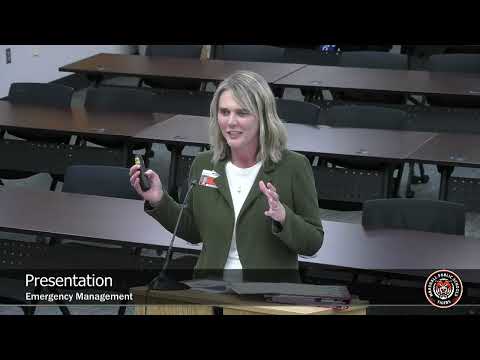
Trisha, who recently took over leadership of the Marshall Public School District's emergency-management team, told the school board the district has rebranded its long-running crisis committee as the Emergency Management Team and is revising decades-old standard operating procedures to reflect modern practice and technology.
"We rebranded ourselves this year and we're now called the Emergency Management Team. So EMT," Trisha said, explaining the shift in emphasis toward prevention, planning and ongoing safety work rather than only reactive crisis response. She said the district has begun a line-by-line review of operating procedures, noting many were created "15–20 years ago" and need updating to reflect changes in technology and practice.
Trisha described three operational changes and tools the district has adopted. First, the district is shifting from an automatic "lockdown" response to a tiered "standard response protocol" recommended by organizations such as the I Love You Guys Foundation; under the new approach, a "hold" instructs classrooms to remain in place and keep hallways clear for lower-level incidents instead of declaring a full lockdown. "Instead of going right into lockdown each time, we've now moved to what's called a hold," she said.
Second, the district uses Raptor Technologies as its visitor-management system. Trisha said the system reads driver's licenses, checks visitors against the registered sex-offender database, supports watch lists across sites and produces check-in reports that help account for visitors during evacuations.
Third, the district relies on Crisis Go as a mass-notification and rostering platform. Trisha said Crisis Go delivers alerts by text, email, app and push notifications and enables teachers to rapidly submit a roster event reporting which students they can physically see, so administrators can identify who is missing in minutes rather than by collecting scattered emails or phone calls. She emphasized training and a key operational rule: teachers should only account for people they can physically see during the roster event.
Trisha also described a new building-mapping tool implemented through a state grant from the Minnesota Department of Public Safety. The Geocom mapping system surveyed each school site, mapped room numbers and critical points—fire extinguishers, AEDs, valves—and allows 911 dispatchers and responders to see not only which building a call came from but where in that building the call originated. That capability, she said, helps responders choose the closest entrance and locate relevant equipment more quickly.
She confirmed each building maintains a Knox box with keys and maps so first responders can access entrances and interior locations when needed. Trisha said the district is also working to create public-facing maps showing AED locations in common areas.
Looking ahead, Trisha said the EMT hopes to host a community tabletop exercise facilitated by the Minnesota School Safety Center, expand collaboration with local law enforcement and dispatch, refine procedures for after-hours events (for example, sporting events and theater performances) and continue staff training. She announced Marshall Public Schools will host an ALICE training on June 5–6 that is open to outside participants.
Board members asked clarifying questions about the platforms and training; Emily, who manages Crisis Go and Geocom settings for the district, answered technical questions about alert sounds and implementation. Trisha said the modernization work will take time but has already produced helpful changes and renewed engagement among the team.