Get Full Government Meeting Transcripts, Videos, & Alerts Forever!
Get email alerts on the Local Budget topic
No spam. Unsubscribe anytime.
Mount Lebanon proposes 3.5% millage increase in balanced preliminary 2026–27 budget
Summary
Mount Lebanon School District presented a balanced preliminary $129.2 million 2026–27 budget that would raise millage 3.5% (1.083 mills) but does not use fund balance; trustees pressed staff on special‑education costs, county reassessment impacts and long‑term pension pressures.
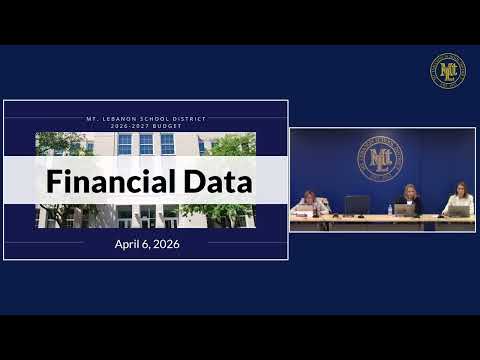
The Mount Lebanon School District on April 6 presented a preliminary 2026–27 budget that projects $129,216,926 in revenue and matching expenditures while avoiding use of the district’s fund balance. District staff proposed a 3.5% millage increase — an additional 1.083 mills — that the presentation said would raise about $2.95 million in real estate tax revenue.
The finance presenter, Mrs. Connelly, told board members the proposed budget is balanced “and does not use fund balance,” and that the district deliberately set the tax increase below the Act 1 index (4.1%) to reduce homeowner impact. Under the proposal the millage would rise from 30.950 to approximately 32.033. Staff gave illustrative monthly impacts: for a $200,000 home about $21.13 per month and about $31.77 per month for a $300,000 home (district slide figures provided by staff).
Why it matters: local property tax revenue comprises the bulk of the district’s funding (about $98.9 million, roughly 76.5% of projected revenue), so shifts in assessed values and refunds materially affect the district’s ability to balance services and reserves. Mrs. Connelly said revenue projections since March increased by roughly $345,712 after the district reduced the proposed tax rate and adjusted collection‑rate assumptions and salary‑driven subsidies.
Budget drivers and tradeoffs: staff highlighted several cost pressures that the budget accounts for, including a substantial employer pension obligation to the Pennsylvania School Employees’ Retirement System (PSERS) — described in the presentation as roughly 33 cents per payroll dollar for 2026–27 — rising health‑insurance costs (an 8.3% increase cited for employee health plans and 3% for dental), expected increases in special‑education tuition and transportation, and a 4% increase to the district’s transportation contract. The district also identified a roughly $619,000 capital shortfall for planned summer buildings-and‑grounds work.
Risks and contingency: presenters listed key fiscal risks: continued decline in the common level ratio (CLR) and resulting collection/refund volatility, pending commercial tax‑appeal litigation that could trigger multi‑year refunds, the possibility that the state’s final budget could provide less basic or special‑education funding than the governor’s proposal, and continuing annual increases in PSERS and health‑care costs. Opportunities the presenters cited included pursuing grants (a facilities grant was recently submitted) and implementation of the district’s comprehensive plan to guide future budgets.
Board reaction and next steps: trustees thanked staff for restoring the fund balance (audited at 5.99% for 2024–25 and targeted at about 6.61% for 2025–26) and pressed staff on both service impacts and external constraints. Several trustees urged Allegheny County to pursue a countywide reassessment, which they said would better realign taxable values across districts; board members referenced a resolution introduced by a neighboring official as a path to action. No final vote occurred at the forum; staff said the district will consider a preliminary final adoption on April 13, 2026, put the budget on public display through May 18, and hold final adoption on May 18, 2026. The district also scheduled a Moody’s meeting on April 29 to discuss fiscal progress.
What remained unresolved: the presentation repeatedly noted that some figures depend on certified real estate values from Allegheny County and final state aid levels, which could require adjustments; the board questioned how ongoing special‑education enrollment growth and outplacement costs will be funded over time. The district’s presentation and Q&A made clear that, while the 2026–27 preliminary budget is balanced without drawing fund balance, it remains sensitive to CLR trends and possible adverse state or legal outcomes.