Get Full Government Meeting Transcripts, Videos, & Alerts Forever!
Get email alerts on the Mental Health topic
No spam. Unsubscribe anytime.
Oak Grove outlines $4.8M mental‑health support system and $392K CBHI grant to expand clinical billing capacity
Summary
District presenters described a multi-tiered mental-health program supporting students across 18 schools, an intern-to-clinician training pipeline and partnerships with community providers. The board heard questions about waitlists, continuity of care and plans to operationalize billing under the Child and Youth Behavioral Health Initiative.
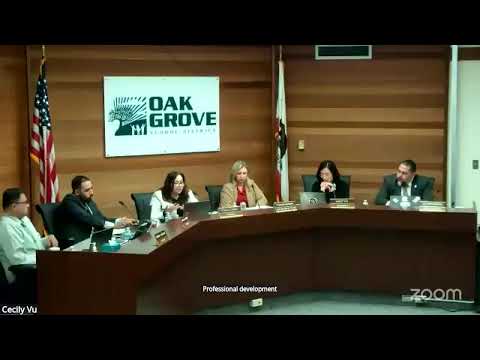
Oak Grove School District staff presented an overview of the district's mental-health systems of support at the March 13 board meeting, describing a tiered model of services, partnerships with community providers and plans to build billing capacity under a state initiative.
Assistant Superintendent Anna and Dr. Jean Viv Dorsy, director of Student, Family and Community Services, said the district estimates roughly $4.8 million in mental-health investments across social work, school psychologists and community partnerships. Presenters described a clinician pipeline led by Jimmy Brown: the district grew from about five interns to 16 and has licensed staff and partners providing additional capacity.
Dr. Dorsy and mental-health staff listed current partners including Alam Rock Counseling Center and Effective School Solutions, and noted 13 school psychologists serve Oak Grove's 18 schools. The district said it secured a $392,000 grant to develop operational capacity for billing under the Child and Youth Behavioral Health Initiative (CBHI), including training, an electronic health record and HIPAA-compliant administrative processes.
Board members asked how students are triaged, how waitlists are managed, and how the district tracks outcomes. Presenters described a referral flow that typically begins with a teacher or Student Success Team and is logged at the school site, with follow-up documentation uploaded to the district student information system (Infinite Campus). They said clinical services vary by program: some community partners bill insurance and can provide longer blocks of clinical services (typically three to six months for certain programs), while district-run intern services aim for continuity of care across the academic year.
Why it matters: Mental-health programming affects attendance, learning and safety. The district is investing both staff time and grant funding to expand services and to pursue a billing model that could sustain more services long term.
What remains unresolved: Presenters acknowledged capacity limits and site-by-site variability (some schools have multiple clinician days; others have limited space) and said waitlists exist. They described steps to expand supervision and clinical capacity but did not announce immediate new hires at the board meeting.