Get Full Government Meeting Transcripts, Videos, & Alerts Forever!
Get email alerts on the Historic Preservation topic
No spam. Unsubscribe anytime.
Tribe outlines preservation plan, memorial options for Mount Pleasant Indian Industrial Boarding School
Summary
Tribal leaders and a pro bono architect presented a multi-year preservation and reuse plan for the Mount Pleasant Indian Industrial Boarding School site, reporting $1.7 million in federal infrastructure funding, emergency mothballing work and plans for a memorial to an estimated 227 former students.
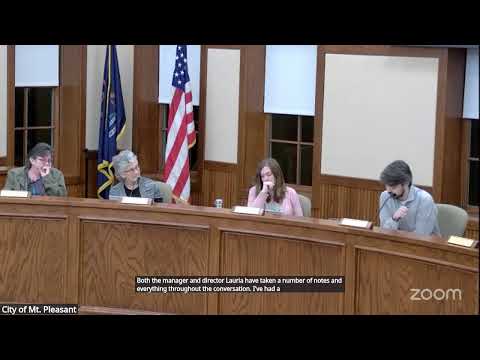
The Sagena Chipua Indian Tribe updated the Mount Pleasant City Commission on March 9 on an ongoing effort to preserve and reuse the Mount Pleasant Indian Industrial Boarding School site, emphasizing repairs already completed, funding secured and a schematic vision for rehabilitation and memorialization.
Eric Rodriguez, the tribe’s interim public relations director, introduced tribal historic preservation officer Marcela Haden, who said the tribe currently owns 15 acres that include seven historic buildings, three of which are priorities for rehabilitation. Haden said the tribe contracted Conwinsky Construction for temporary roof and weatherproofing work, spending $32,000 on "mothballing" to stabilize buildings and prevent further deterioration.
Haden said the tribe won a $1.7 million grant from the Bipartisan Infrastructure Law to support the project and has also received two National Park Service tribal heritage grants totaling $46,000 and a smaller National Endowment for the Humanities grant tied to local documentation work. The tribe has hired subcontractors including Environmental Resource Group and Green for Life and engaged preservationist Jessica Flores to produce an architectural assessment and a historic preservation plan; Flores recommended against demolishing the historic structures.
"We don't want to demolish any of the buildings," Haden said, adding the work includes hand-scraping historic wood and temporary glazing to reduce mold and moisture.
Haden described community and volunteer efforts, including an onsite day of service from Procter & Gamble staff, and said the tribe is developing a website to provide descendants with access to records. She said research to identify former students is ongoing and that current research has identified 227 individuals who attended the school; the tribe is still investigating burial locations and other records.
Pro bono architect Christian Nakarado presented schematic designs and a strategic vision for reuse of the three priority buildings. Nakarado described a "light touch" approach intended to preserve building fabric and let the sites "speak," while making limited accessibility upgrades, restoring masonry and opening historically blocked window openings. He proposed using the workshop building first as a community and exhibition space with offices, studios and a small archive; the gymnasium and classroom building would be stabilized and used as exhibition and language/reading spaces.
On the classroom building, Nakarado said the design team proposes permanently closing the east ceremonial threshold and creating a new, accessible entry on the opposite side to symbolically ensure "no native kid is ever going to have to cross that threshold again." He also proposed a contemporary, transparent central roof element—inspired by teaching-lodge precedents—to link new ceremonial architecture with the site's historic masonry.
Haden said the tribe recently engaged Sharon Ferraro to advance their state-level National Register nomination to the National Park Service; the state review board voted unanimously to forward the nomination to Washington, and the tribe expects a federal decision within about 45 days. Next steps listed by Haden include soliciting masonry bids, compiling renderings and cost estimates into a project booklet, and finalizing a funding plan with tribal administrator Dustin Davis.
Commissioners thanked presenters and asked about digitization and oral-history work; Haden said digitization is underway via a partner organization and that oral-history efforts will focus on descendants rather than survivors, because few people who attended the school are still living.
The tribe asked for continued collaboration and community input as the project moves from emergency repairs to preservation, programming and fundraising.