Get Full Government Meeting Transcripts, Videos, & Alerts Forever!
Get email alerts on the Stormwater Turbidity topic
No spam. Unsubscribe anytime.
Belmont workshop weighs continuous turbidity sensors, staff recommends not requiring them
Summary
City engineers, county staff and lake advocates debated autonomous turbidity monitors, numeric thresholds and practical enforcement. Staff recommended not to add a mandatory monitoring requirement to Belmont’s ordinance, citing data‑quality, placement and enforcement burdens.
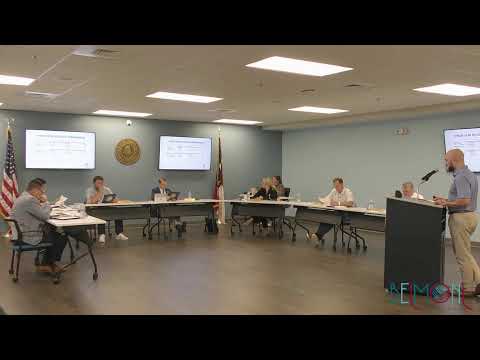
Belmont City Council members and staff spent the bulk of a workshop session reviewing erosion, sedimentation and turbidity concerns tied to local construction and proposed use of continuous turbidity monitors as an early‑warning tool.
City engineer Kate Goodman summarized technical background and local experience, telling the council that Belmont currently does not administer its own erosion‑control program and that Gaston County handles permitting and enforcement. "We do not have our own program. So that is administered by the county," Goodman said, and she warned that monitors placed in large water bodies can pick up upstream or backwater turbidity that is not traceable to a single site.
Speakers reviewed the regulatory history: an EPA guidance level of 280 NTU for large construction sites was proposed in 2010 but effectively withdrawn after a 2013 settlement, leaving numeric approaches to states and localities. Goodman told the council that peer jurisdictions such as Charlotte use grab sampling or event‑triggered sampling in critical watersheds and treat turbidity readings as indicators that prompt inspection rather than as an independent enforcement metric.
Gaston County staff and the county’s plan reviewer emphasized limits of enforcement capacity. John, with Gaston County Natural Resources, said the county enforces plans delegated by the state and inspects permitted sites on a cycle rather than continuously; Joseph B., the county road control and stormwater manager, noted inspectors do not perform routine rain‑event monitoring and that enforcement follows documented off‑site sedimentation or other clear evidence.
Advocates for continuous monitoring, including the Lake Wye Commission’s executive director Neil Brennan and a Riverkeeper representative, described monitors as a practical alert system. Brennan said the monitors are "an alert system to let people know if there's a problem with the erosion control measures that are there already been approved and the county enforces" and argued developers can bear the cost. The community speakers also cited Virginia-style numeric approaches that compare daily readings or upstream/downstream deltas as a model for triggering corrective action.
Staff and county officials raised technical and fiscal concerns: the council heard that monitor readings vary with siting, calibration and upstream watershed events; some field monitors produced spikes that did not correlate to local rainfall, raising data‑quality questions. Goodman provided vendor and peer cost figures discussed in the meeting: per‑monitor purchase/installation estimates and recurring calibration/communications fees were presented as potentially material (staff cited example per‑monitor purchase/installation and monthly operating costs). Councilmembers asked whether requiring monitoring (without creating new enforcement duties for the city) would create unintended obligations; staff cautioned that collecting and interpreting continuous data is resource‑intensive and that alarms alone should not automatically trigger city action.
Miles, the city manager, summarized staff’s recommendation: Belmont would not require automated turbidity monitoring in its ordinance at this time. "My recommendation would be that we're not want to require turbidity," Miles said. The council accepted the information and directed staff to continue addressing erosion concerns through conditional zoning, plan conditions and coordination with Gaston County.
Next steps: staff will continue to use conditional zoning and project‑specific conditions to pursue preventive measures (larger buffers, phased construction plans, diversion ditches and other proven controls) and to coordinate with Gaston County when monitoring data indicates a potential failure. No ordinance change or new mandatory monitoring requirement was adopted at the workshop.