Get Full Government Meeting Transcripts, Videos, & Alerts Forever!
Get email alerts on the Lpp Guidelines topic
No spam. Unsubscribe anytime.
Transportation Commission staff preview 2026 Local Partnership Program guidelines, confirm $200 million annual appropriation
Summary
Commission staff previewed proposed 2026 updates to the Local Partnership Program, emphasizing clarifications to cost-savings and reporting rules, stronger equity and workforce language, and a timeline that would open competitive applications in late 2026 with final awards in summer 2027.
Lashara Ward, associate deputy director for the Transportation Commission, opened the Local Partnership Program workshop by confirming the program’s annual appropriation remains $200 million and outlining how that sum is split between the competitive and formulaic tracks.
The workshop, the first in a series to develop 2026 guidelines, focused on clarifying language and targeted updates rather than sweeping policy changes. "The objective of the Local Partnership Program is to provide funding to counties, cities, districts, and regional transportation agencies that have voter‑approved taxes or fees dedicated solely to transportation improvements," Ward said, adding that the program was established under Senate Bill 1 to match state funds with locally generated revenue.
Why it matters: the LPP’s guidelines govern what types of local revenues qualify, how applications are evaluated and how funds are programmed; small wording changes can affect eligibility, evaluation outcomes and audits. Staff told stakeholders they will continue a two‑year program period for 2026 but reserve the right to alter the cycle length before the commission adopts final guidelines.
Key proposed changes and supports discussed at the workshop include:
- Equity supplement: staff said they will expand the equity supplement and hold an interagency workshop with the interagency equity advisory committee to refine community‑engagement expectations. Beverly Newman will lead equity coordination for the SB1 programs.
- Workforce development: staff signaled a push to strengthen language encouraging local hiring and job creation metrics; Naveen Habib was identified as overseeing workforce elements tied to the SECP program and cross‑program coordination.
- Land use and pro‑housing criteria: staff are updating guidance and evaluation criteria in partnership with the Department of Housing and Community Development to help applicants better describe how projects advance transportation‑efficient land use and housing goals.
- CAPAI 2.0 strategies: staff said they will incorporate CAPAI 2.0 strategies where relevant, noting these affect some SB1 programs more than others.
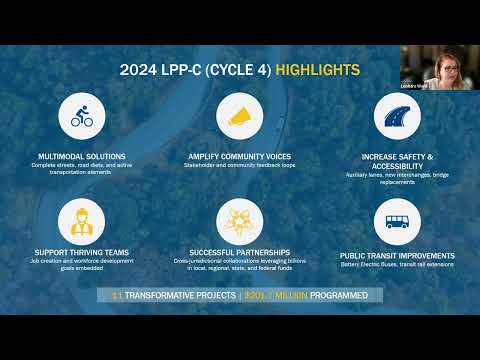
Staff also reviewed recent program performance: the competitive track has been used to fund projects in rail, transit, bicycle and pedestrian infrastructure and zero‑emission transit procurement, while the formulaic track supports programming across eligible agencies. Kayla Gy, assistant program manager for LPP, said the formulaic program currently lists about 46 eligible agencies and noted available balances in current cycles.
On timeline, staff described a schedule that would post draft guidelines and take stakeholder input in spring, adopt draft guidance with the commission in June, open the competitive call for projects in late summer and receive applications typically due in late November, with evaluations continuing through mid‑2027 and final awards adopted in summer 2027.
What staff will do next: workshop materials and the presentation will be posted to the program web page; staff committed to follow up with stakeholders on clarifying language in the draft guidelines and to hold additional workshops and office hours for one‑on‑one support.
The workshop ended with an invitation for written comments from stakeholders and a reminder that staff will incorporate feedback as they refine the 2026 guidelines.