Get Full Government Meeting Transcripts, Videos, & Alerts Forever!
Get email alerts on the Food Insecurity topic
No spam. Unsubscribe anytime.
Senate committee hears unanimous appeals for food assistance: bills to fund food banks, SNAP outreach and medically tailored meals laid over after amendments
Summary
Witnesses from regional food banks, food shelves and health systems urged lawmakers to shore up food assistance; the committee adopted technical amendments and laid over multiple bills including a regional food bank grant, SNAP outreach restoration (A3 amendment adopted) and funding for prepared meals and food shelves.
Lawmakers on the Senate Health and Human Services Finance and Policy Committee on March 5 heard hours of testimony urging sustained state investment in food assistance programs and measures to blunt federal cuts to SNAP. Advocates described surging demand, record food-shelf visits and risks to program continuity unless lawmakers provide predictable funding.
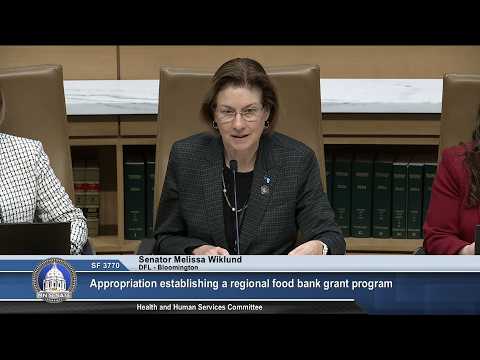
Senator Baldwin introduced Senate File 3770, a proposal to create a regional food bank grants program to provide ongoing, predictable funding for regional food banks that support nearly 500 food shelves statewide. An author's technical amendment was offered and adopted by voice vote, and the bill was laid over for possible future consideration.
"One in five Minnesota families cannot afford the food they need," Shane Morris, president and CEO of Second Harvest Northland, told the committee, describing nearly 11 million meals distributed by his network regionally and a 16% surge in food-shelf use after a federal SNAP pause. "We need reliable and consistent base funding so we can be available when our Minnesota neighbors need us." Virginia, executive director of Channel One Regional Food Bank in Rochester, said her partner agencies rely on the regional food bank to supply as much as 80–95% of the food they distribute.
Senate File 8.49, aimed at restoring funding lost when the USDA reduced its SNAP outreach reimbursement rate, received an A3 amendment that replaces the federal shortfall with state funds; the amendment was adopted and the bill was laid over. Tina England of Second Harvest Heartland said outreach grantees supported completion of nearly 35,000 SNAP applications and warned that reduced outreach would increase incomplete forms, county processing burdens and payment errors.
Leah Hebert Wells, CEO of Open Arms of Minnesota, and Faye Salty of Fairview Health Services testified in support of Senate File 14-12, which would extend a prepared-meals grant program that funds medically tailored meals for people with serious health conditions. Testifiers said the program improves health outcomes and reduces caregiver strain; the committee adopted a technical amendment to the bill and laid it over.
Witnesses supporting Senate File 3904 and related proposals asked the committee to update base funding for the Minnesota Food Shelf Program to match historic demand. Stephanie Lehman, executive director at AC DC Food Shelf, and other local food-shelf leaders told senators that visits have risen sharply — in some cases more than doubling from pre-pandemic levels — and that rising food costs and depleted donated supply make state backing essential.
Senate File 4061, described by sponsors as a state-funded bridge to protect Minnesotans at immediate risk of losing SNAP benefits due to new federal verification and work-rule changes, generated discussion about county capacity to carry out more robust eligibility determinations. Melissa, a Minnesotan who described multiple renewals and bureaucratic hurdles in past years, urged protections for people balancing work, health and complex paperwork; the Minnesota Grocers Association emphasized the downstream economic effects, noting SNAP recipients spent more than $850 million with eligible retailers in 2024.
No bill received a final committee vote; each measure with testimony was laid over for further consideration. Committee members asked staff and sponsors to work with counties and state agencies on implementation details, especially around eligibility assessment and county systems for SNAP-related proposals.
The committee adjourned after hearing the package of food-security bills and testimony from dozens of nonprofit and health-system witnesses.