Get Full Government Meeting Transcripts, Videos, & Alerts Forever!
Get email alerts on the Labor Policy topic
No spam. Unsubscribe anytime.
Senate labor panel advances bill to ban 'stay-or-pay' training repayment agreements
Summary
The Minnesota Senate Labor Committee voted to recommend passage of Senate File 2533, sponsored by Sen. Mann, which would prohibit employer "stay-or-pay" or "training repayment" agreements except for narrowly defined transferable credentials and recognized apprenticeship programs. Supporters called them "traps" that limit worker mobility; business groups warned of unintended effects on employer-sponsored training.
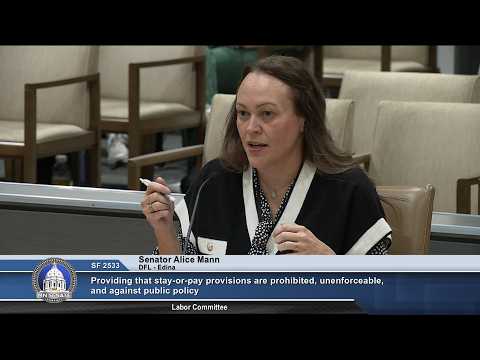
The Senate Labor Committee on Monday advanced Senate File 2533, a measure from Sen. Mann that would bar so-called "stay-or-pay" or "training repayment" agreements that require workers to repay alleged training costs if they leave a job.
Sen. Mann, the bill sponsor, said the contracts "effectively trap workers in jobs they don't want to be in" and described cases in which nurses, hairstylists, groomers and truck drivers were later charged thousands of dollars for training that either was unclear or did not occur. "These agreements require workers who receive on-the-job training ... to pay back the alleged cost of the training if they leave their jobs," Sen. Mann said during opening remarks.
Chris Hicks, senior policy advisor at Protect Borrowers, testified in support and said long-term research and litigation show the clauses chill worker mobility and let employers use debt collection as leverage. "These terms are employment terms that force workers to pay their employers when they leave their jobs," Hicks told the committee.
An Prakashan, a partner at Nichols Hester who has worked on class actions involving "stay-or-pay" contracts, said the provisions can function as penalties that resemble "indentured servitude" and urged a private right of action and fee-shifting so affected workers can obtain counsel. "Without guardrails of law these contracts begin to function as a penalty," Prakashan said.
Business groups including the Minnesota Chamber of Commerce and the Minnesota Business Partnership opposed the bill as drafted. Lauryn Schothorst, the chamber's workforce policy director, said a blanket ban would sweep away widely used arrangements — from sign-on and relocation agreements to tuition reimbursement and retention bonuses — and could make employers less willing to provide training. "A blanket prohibition on these types of agreement negatively impacts employees as employers simply won't make these arrangements available," Schothorst said.
Dalton Danielson, policy director for the Minnesota Business Partnership, warned that removing the ability to recoup certain investments would reduce employers' willingness to make long-term investments in workers and could narrow advancement pathways for entry‑level and career‑changing employees.
Committee members and witnesses spent much of the hearing debating key definitions and exceptions. Senators repeatedly pressed for a clear distinction between employer‑specific on‑the‑job training and genuinely transferable or market‑recognized credentials. Sen. Dornink and others asked what would qualify as "transferable" and whether commonly used practices — such as employer‑paid tuition, sign‑on bonuses, relocation reimbursement and CDL training — would be covered by an exemption. Sen. Mann and witnesses said the A4 amendment is intended to exempt recognized, market‑portable credentials and apprenticeship programs and that clarifying statutory language could be added.
The Department of Labor and Industry provided a fiscal note projecting administrative costs to implement the bill. A DOLI representative (Mr. Moore) told the committee the department estimated additional workload equal to roughly 1.4 full‑time equivalent staff to carry out responsibilities associated with the measure.
On legal remedies, committee counsel and witnesses noted that Minnesota currently has limited statutory remedies for these agreements and that plaintiffs often face forum, choice‑of‑law and practical cost hurdles. Advocates urged including a private right of action with fee recovery to make enforcement feasible. Witnesses referenced federal statutes and other states' actions in discussing enforcement analogues but said the proposed Minnesota law would provide clarity.
After extended questioning and discussion about hypotheticals, prorated repayment formulas and carve‑outs for apprenticeships and certain certifications, the committee adopted the A4 amendment earlier in the hearing and then voted to recommend Senate File 2533 as amended to pass and be re‑referred to the Judiciary and Public Safety Committee. Sen. Marty moved the committee recommendation; the motion passed by voice vote.
The committee invited further drafting conversations with the bill sponsor to clarify exceptions and proration mechanics before returning the bill for additional committee consideration. The Senate Labor Committee adjourned following the vote.