Get Full Government Meeting Transcripts, Videos, & Alerts Forever!
Get email alerts on the Libraries Digital Access topic
No spam. Unsubscribe anytime.
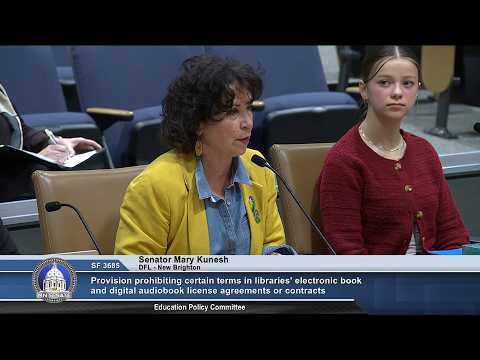
Senate committee hears library groups on e‑book licensing; bill moved to State & Local Government amid legal and market questions
Summary
Senate File 36‑85, aimed at constraining restrictive e‑book license terms for public and K–12 libraries, drew testimony from library leaders who said current contracts inflate prices and limit access; senators asked about constitutional and market impacts before recommending the bill to the Committee on State and Local Government.
Senator Cornish introduced Senate File 36‑85, a proposal to limit contract terms that libraries may agree to with e‑book vendors and to create more equitable, sustainable digital licensing for public and K–12 school libraries. Proponents framed the bill as a contract‑law approach — modeled in part on legislation passed in Connecticut — intended to protect taxpayer dollars and preserve access without regulating publishers’ copyrights.
Sarah Hawkins, introduced herself as the assistant director at Anoka County Library and legislative chair of the Minnesota Library Association, testified the current licensing model requires libraries to "pay significantly higher prices for digital copies than for physical books," that many licenses expire after two years or roughly 26 checkouts, and that nondisclosure clauses prevent libraries from sharing contract terms. She said these market features force repeated repurchases and constrain collections, harming access for rural and small libraries and users who need accessible formats.
Student and school library testimony underscored demand and accessibility: a high school student and school library media specialists said e‑books and audiobooks provide critical flexibility for busy students and essential accessibility features for readers with disabilities.
Regional library directors described scale and strain: a metro consortium reported roughly 13.9 million digital checkouts and $6.5 million invested in 2025, while citing an estimated unmet demand figure and average wait times (testimony cited an average wait of about 55 days for popular e‑books). Supporters urged using contract law to bar clauses that limit interlibrary lending, require repeated purchases, or impose nondisclosure that prevents libraries from advocating for fair terms.
During Q&A, senators pressed proponents on second‑order market effects and constitutionality. Senator Duckworth and others asked whether prohibiting certain contract clauses could prompt vendors to stop supplying titles to Minnesota libraries or otherwise raise prices; supporters said the bill targets how public funds are spent and seeks to protect libraries’ purchasing power. The sponsor noted similar approaches in other states and framed the measure as consumer‑protection and procurement law rather than copyright regulation.
Senator Cornish moved that SF 36‑85 be recommended to pass and referred to the Committee on State and Local Government; the motion carried by voice vote. Sponsors and library advocates urged continued stakeholder conversations — including publishers, counties and school districts — as the bill proceeds.
Why it matters: The bill would change procurement contracting norms for publicly funded libraries and school systems, with implications for access, budgets, and publisher/library markets. Lawmakers voiced interest in hearing more from publishers, county systems and legal experts before final action.
Next steps: SF 36‑85 was recommended to the Committee on State and Local Government for further consideration.