Get Full Government Meeting Transcripts, Videos, & Alerts Forever!
Get email alerts on the Permanent School Fund topic
No spam. Unsubscribe anytime.
Minn. task force recommends moving Permanent School Fund to a 4.5% rolling‑average distribution; constitutional amendment proposed
Summary
A bipartisan task force recommended amending the Minnesota Constitution and statute so the Permanent School Fund pays out 4.5% of a three‑year rolling average of market value, models show distributions would rise immediately while preserving long‑term purchasing power; the Legislature advanced the proposal for voter review in 2026.
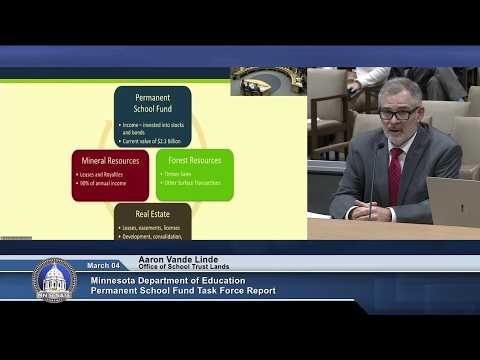
A bipartisan panel convened by the Legislature recommended replacing Minnesota's interest‑and‑dividend distribution rule with a market‑value‑based formula that would make 4.5% of a three‑year rolling average available for distribution, the panel and State Board of Investment staff told the Senate Education Committee on March 4.
The task force, created in May 2024 to study the Permanent School Fund and school trust lands, unanimously endorsed recommendations to amend the Minnesota Constitution to state the fund's enduring purpose while putting operational distribution rules in statute. Under the bill before the committee, the constitutional change would be submitted to voters at the 2026 general election and, if approved, the statutory distribution rule would take effect for apportionments beginning in September 2027.
Task‑force presenters and State Board of Investment (SBI) staff said they modeled multiple scenarios and concluded a 4.5% distribution based on a three‑year rolling average is consistent with common practice among large educational endowments and would moderate year‑to‑year volatility. SBI modeling presented to the committee showed that, in a baseline market scenario, distributions from the fund would nearly double relative to current distributions while the fund's market value would continue to grow in most modeled outcomes.
"Using a three‑year rolling average reduces year‑to‑year volatility while remaining responsive to prolonged market downturns," the deputy director for the State Board of Investment said in the presentation. The task force also highlighted that the current constitutional rule — which limits distributions to net interest and dividends and directs capital‑gain offsets in loss years — prevents most realized appreciation from being available for current beneficiaries.
Committee members asked about the potential to grow the fund through additional land or mineral development. The director of the Office of School Trust Lands told the committee that known nonferrous mineral deposits (copper, nickel, gold, palladium, platinum) and helium on trust lands could materially increase revenue and said, based on available estimates discussed in the hearing, exploiting certain deposits could add roughly $3 billion to the trust if developed.
The hearing included questions about SBI governance and whether environmental, social and governance (ESG) considerations could affect returns. An individual senator raised concerns that proxy voting or other influence activities could be counterproductive to maximizing revenue from resource‑rich areas. SBI Executive Director Joe Shirts and SBI investment staff responded that the board's first obligation is fiduciary, that investment authority is delegated to professional staff under policy, and that SBI does not pursue divestment campaigns as policy; they said investment decisions are made with attention to material risks and opportunities.
The committee also debated a last‑minute amendment that would have enshrined equal per‑pupil apportionment in the constitution rather than leaving apportionment details to statute. Sponsors argued equal per‑pupil language would guarantee uniform distribution of the trust across the state; opponents and task‑force members urged leaving apportionment policy to statute so future adjustments could be made without another constitutional change. The voice vote rejected the amendment.
Committee leadership moved the constitutional amendment and statutory package forward; the bill was recommended to the next legislative steps that would put the proposed constitutional question before voters. The task force emphasized that moving distribution mechanics to statute preserves flexibility for future legislatures while the constitution would retain the fund's perpetual‑purpose protections.
If approved by voters in 2026, the measure would change how much and how distributions are calculated for the more than 380 public school districts and charter schools that are beneficiaries of the Permanent School Fund. The committee record shows the proposal was advanced for further legislative consideration and placement on the 2026 ballot.