Get Full Government Meeting Transcripts, Videos, & Alerts Forever!
Get email alerts on the Budget Forecast Access Fund topic
No spam. Unsubscribe anytime.
February forecast shows smaller DHS spending changes but Access Fund still faces structural challenges
Summary
DHS and MMB told senators that November forecast drivers (managed‑care rate increases and HR1 effects) produced large spending pressures but the February 2026 forecast showed smaller near‑term changes and some one‑time timing shifts; MMB reported the Healthcare Access Fund improved to a roughly $11 million positive balance in FY27 but retains a structural deficit in later years.
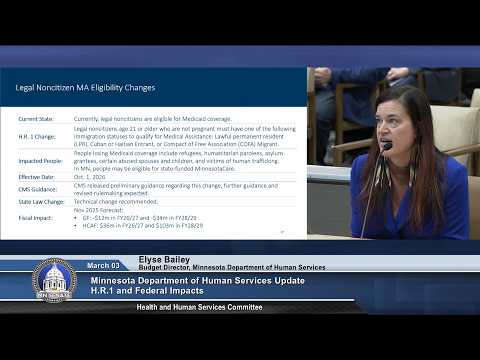
Department of Human Services and Minnesota Management and Budget officials briefed the Senate Health and Human Services Finance and Policy Committee on March 3 about the November and February budget forecasts and the HealthCare Access Fund outlook.
MMB director Josh Reason said provider tax collections and updated actuals raised revenue projections after the November forecast, and that technical timing differences improved the fund's near‑term position. The February forecast produced a roughly $11 million positive balance in FY27 for the Access Fund, an improvement from the November tail projection that showed a large negative balance in later years. Reason cautioned, however, that the fund retains a structural imbalance in the out biennium driven primarily by MinnesotaCare expenditure growth and limitations on revenue options imposed by HR1.
DHS budget director Elyse Bailey and MMB walked senators through the drivers: managed‑care interim rate adjustments (DHS updated rates that raised spending in the November forecast), changes in BHP/federal premium tax credit flows that reshape federal/state shares for MinnesotaCare, and a DHS prepayment review process for 14 high‑risk services that shifted payment timing and reduced billings. DHS said the prepayment review produced a two‑week payment delay that created a $53 million one‑time timing reduction, a small denial rate observed in the first cycle (~0.2%), and an estimated ongoing reduction in billed amounts for those services (~4% in observed weeks), which DHS estimated would save roughly $75 million in the current biennium and about $99 million in the tails.
Senators asked technical questions about the forecast assumptions. Sen. Utke confirmed that "stronger" provider tax collections meant growth in the taxable base (higher healthcare spending), not stronger enforcement. Sen. Lieske asked about MNSURE carryforward appropriations; Reason explained those are time‑limited appropriations that do not convert to ongoing revenue without legislative action.
What’s next: DHS and MMB will refine estimates as more data arrive and committee members requested further detail on cost drivers and any legislative options to address the Access Fund's out‑biennium gap.
Sources: DHS and MMB presentations to the Health and Human Services Finance and Policy Committee, March 3, 2026 (Elyse Bailey, Josh Reason).