Get Full Government Meeting Transcripts, Videos, & Alerts Forever!
Get email alerts on the Funeral Workforce topic
No spam. Unsubscribe anytime.
Senate committee hears bills to ease mortician shortages by altering reciprocity and internships
Summary
Witnesses told the Senate Health and Human Services Committee that Minnesota’s bachelor‑degree requirement and internship timing create barriers to hiring and retaining licensed morticians. One bill would allow experienced out‑of‑state morticians to qualify for reciprocal licenses; another would let students begin internships while still enrolled in mortuary programs.
The Minnesota Senate Health and Human Services Finance and Policy Committee on March 4 heard two bills aimed at easing workforce shortages in funeral service.
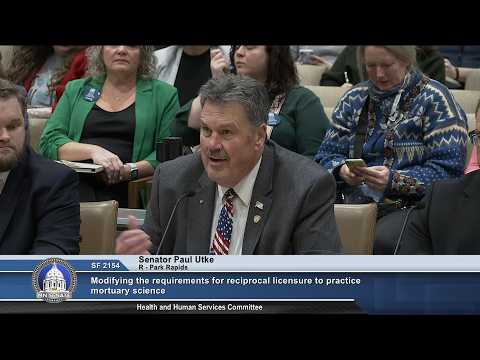
Senator A Key introduced Senate File 2154, which would create an alternative reciprocal‑licensing pathway allowing experienced out‑of‑state morticians to qualify for Minnesota licensure by documenting at least three years of practice and a set number of case involvements, while still passing required exams and meeting continuing‑education requirements. "Minnesota is one of only four states in the country that requires a bachelor's degree to practice mortuary science," Jordan McCreevy Sites, president of the Minnesota Funeral Directors Association, told the committee, arguing the requirement blocks experienced practitioners from other states.
Industry witnesses provided data on staffing shortages. "Minnesota currently only has 51 licensed funeral directors for every 100 open positions," JD Time, identified as vice president of funeral practice with Burton, said, adding that more than half of Minnesota's licensees are age 55 or older and the state could need roughly 552 additional morticians by 2029. Supporters said SF 2154 would maintain exam and safety standards while recognizing hands‑on experience from other jurisdictions.
Senate File 2155 would modernize internship requirements so students enrolled in accredited mortuary science programs may begin registered internships before graduating, allow alternate supervising licensees so interns’ training is not disrupted, and require that students performing embalming or restorative surgical procedures be in the physical presence of their supervisor. Proponents said earlier hands‑on experience should improve retention and expand the pipeline into the profession.
Committee members asked whether national standards provide sufficient preparation for practitioners coming from other states and whether universities would need to change curricula; witnesses said the national standard commonly involves an associate degree and a national board exam, and that the University of Minnesota’s program director indicated support for the changes. The committee laid both Senate Files 2154 and 2155 over for further consideration.
The committee did not take a final vote on either bill. Further action will be set as members consider whether to advance these measures individually or combine them with other licensure items.