Get Full Government Meeting Transcripts, Videos, & Alerts Forever!
Get email alerts on the Health Medicaid HR1 topic
No spam. Unsubscribe anytime.
DHS warns federal ‘HR1’ changes will shift costs to Minnesota, add implementation strain and risk federal penalties
Summary
DHS budget director Elyse Bailey told the Senate Health and Human Services Finance and Policy Committee that HR1’s changes to Medicaid eligibility, retroactive coverage, work requirements and provider funding will increase state costs, require major systems work and risk loss of federal matching funds if Minnesota fails to implement tight deadlines.
Elyse Bailey, budget director at the Minnesota Department of Human Services, told the Senate Health and Human Services Finance and Policy Committee on March 3 that the federal law known as HR1 (enacted July 4, 2025) will force wide changes in how Minnesota operates Medicaid and related programs and that those changes would “be felt by all Minnesotans, not just folks that rely on Medicaid.”
Bailey said HR1 requires states to adopt several new rules — including work or community‑engagement requirements for adults ages 21–64 without dependent children, six‑month redeterminations for the adult expansion population, and shorter periods of retroactive eligibility — that will increase administrative complexity and, absent state-law changes, shift costs to Minnesota. She told the committee DHS is modeling some HR1 effects in the forecast but that many provisions cannot be implemented without state legislation or further federal guidance.
Why it matters: DHS serves roughly 1.2 million enrollees and administers about $24 billion in program spending in FY26; Bailey said changes that reduce federal funding or broaden state-paid populations could substantially raise Minnesota’s costs and place more financial strain on hospitals and other providers.
What DHS described
- Work requirements: HR1 would require people 21–64 who lack dependent children and who are not pregnant or disabled to meet roughly an 80‑hours‑per‑month activity standard (work, community service, a work program, or half‑time school as defined by the institution). Bailey said mandatory and optional exemptions exist in the law and noted implementation depends on CMS guidance and state statute changes; the effective date DHS is planning for is Jan. 1, 2027.
- Renewals and retroactive coverage: HR1 shortens federal retroactive eligibility windows (one month for expansion adults, two months for other groups) and requires six‑month renewals for the adult expansion group rather than annual redeterminations. DHS said Minnesota law currently allows three months of retroactive coverage and that continuing that period beyond federal limits would require state funds to pay the difference.
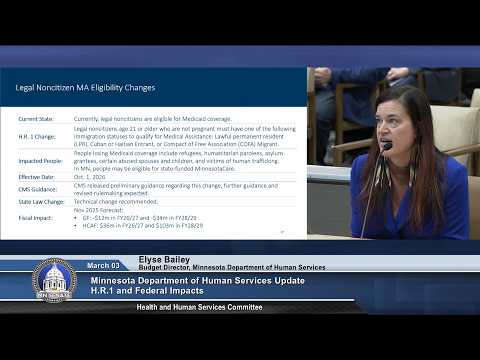
- Cost‑sharing and immigrant eligibility: HR1 permits some cost‑sharing for expansion adults (limits in the federal law apply) and significantly narrows which lawful noncitizens are eligible for Medicaid; many cohorts would instead be eligible for state‑funded MinnesotaCare, changing which services (for example, long‑term care) are available and shifting costs to state programs.
- Provider taxes and directed payments: HR1 prohibits new or increased provider taxes enacted after July 4, 2025, phases down the allowable tax ceiling over time, and limits state-directed payments (for expansion states) to 100% of Medicare rate in some cases. Bailey said Minnesota has pending waiver requests for payments enacted in 2025 and is awaiting CMS actuarial review.
Implementation risk and timelines
Bailey told senators the implementation timeline is compressed: several HR1 provisions are effective Oct. 1, 2026, and many take effect Jan. 1, 2027. DHS has already begun systems planning, worker procedure updates, and partner outreach but said it needs legislative authority, appropriations, and more detailed CMS guidance to finalize operational plans. Bailey warned the committee that, without state law changes and funding, Minnesota risks both coverage loss for enrollees and exposure to federal penalties.
On potential penalties: Bailey said the department had not received specific guidance on penalty amounts but that DHS was preparing for a worst‑case outcome. "We are assuming the penalty could be the whole federal share for the expansion population," she said, noting that could be a large financial exposure for the state.
Committee reaction
Several senators pressed DHS about resources and timing. Sen. Lieske asked whether DHS had posted an RFP for vendor support; Bailey said DHS planned an RFP for work‑requirements support and was using some previously appropriated systems funds but had not issued the solicitation yet. Sen. Mann expressed urgent concern about service disruptions and hospital impacts if federal funding declined; Bailey said DHS was “very concerned” and working to mitigate harm.
What’s next
Bailey said DHS will continue developing implementation plans, pursue needed legislative changes, coordinate with counties and tribes, and further refine fiscal impacts for the legislature. She emphasized that many provisions will require changes to Minnesota law to avoid shifting federal costs to state funds.
Sources: DHS presentation to the Health and Human Services Finance and Policy Committee, March 3, 2026 (Elyse Bailey).