Get Full Government Meeting Transcripts, Videos, & Alerts Forever!
Get email alerts on the Audit topic
No spam. Unsubscribe anytime.
Cary auditors anticipate clean opinion but cite two material weaknesses; investigations continue
Summary
External auditors told Cary Town Council they expect to issue an unmodified ("clean") opinion for FY2025 but identified two material weaknesses — weaknesses in the control environment tied to the former town manager's conduct and a $2.1 million grant receivable that was not recorded — and noted ongoing outside investigations.
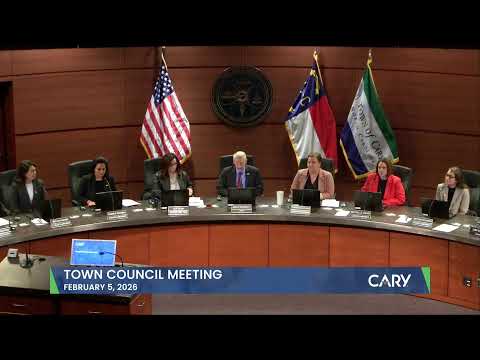
The Cary Town Council on Feb. 5 heard from its external auditors that the town's fiscal 2025 financial statements are expected to receive an unmodified opinion even as the audit identified two material weaknesses and other issues that warrant follow-up.
Leanne Waters, engagement director for Cherry Beckard, told the council the audit team plans to issue "unmodified opinions on the financial statements and on the federal single audit" after completing final quality reviews. But Waters said auditors found two material weaknesses: a control‑environment deficiency related to the "tone at the top" and a material audit adjusting entry — a $2.1 million grant receivable and matching intergovernmental revenue that had not been recorded in the capital projects major fund.
Waters described the first weakness as a breakdown in leadership messaging and ethical tone by the former town manager that left some employees feeling there was a risk of retaliation if they raised concerns. She recommended the council regularly evaluate employee perceptions with anonymous surveys and strengthen whistleblower and anti‑retaliation protections.
The second material weakness arose when auditors reconciled the town's schedule of expenditures of federal and state awards to the general ledger and identified the unreconciled $2.1 million item. "We were out by that $2 million; we just couldn't identify it," Waters said. Staff and auditors confirmed the expense had been recorded but the related receivable had not been booked; auditors recommended improving financial close and grant‑reconciliation processes.
Auditors also disclosed a separate incident of outside check fraud in April 2025 for about $1.3 million; the town's bank recovered the funds and auditors said the town suffered no financial loss. Waters said auditors had no internal‑control recommendations tied to that specific external fraud because it appeared to have occurred outside town processes.
The audit team offered additional best‑practice suggestions, including adopting a policy for benefits provided to elected officials, clearer policies for travel and regional trips, and tightening P‑Card receipt requirements and digital receipt processes.
Assistant Town Manager Dana Whitmar and Finance Director Kimberly Branch told the council these audit results reflect actions taken in 2024–25 to stabilize finances while other inquiries (the State Auditor, an outside procurement review and a criminal inquiry by SBI) continue. Branch said the town will submit its final Annual Comprehensive Financial Report to the Local Government Commission by Feb. 12.
Council members pressed auditors on scope and sampling, bond‑rating implications and the fund‑balance calculation; Waters said questions about bond ratings were best directed to the town's bond advisor, and that auditors focus on material misstatements and major programs. Council members pressed staff for clearer public disclosures about fund‑balance composition and next steps to implement auditor recommendations.
Next steps identified at the meeting include staff and council follow‑up on the auditor recommendations, an internal implementation group to address controls and anti‑retaliation protections, and completion of parallel outside reviews already underway.