Get Full Government Meeting Transcripts, Videos, & Alerts Forever!
Get email alerts on the Public Welfare topic
No spam. Unsubscribe anytime.
Council approves $7.75M emergency supplemental to support nonprofits, food assistance and housing stabilization
Summary
After a public hearing with dozens of nonprofits and family witnesses, the Montgomery County Council unanimously approved a $7.75 million supplemental appropriation to fund food assistance, nonprofit capacity, SHARP housing stabilization and the Office of Food Systems Resilience, with technical edits to speed disbursement.
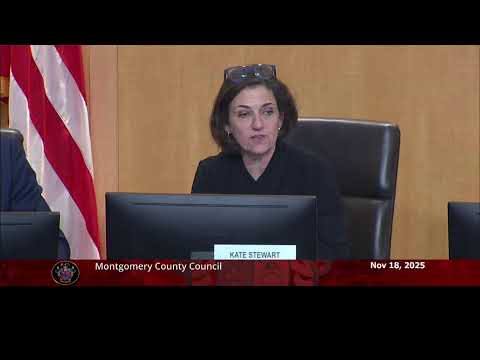
The Montgomery County Council voted unanimously on Nov. 18 to approve a multi-part supplemental appropriation intended to help nonprofit service providers respond to sharp, immediate needs following federal benefit disruptions and broader economic stresses.
What passed: The council approved $7.75 million in total emergency funding allocated across several priorities: strengthened food-assistance purchases and distribution channels; a nonprofit sustainability grant pool; targeted short-term housing stabilization funds (SHARP) to prevent evictions; and operational support for the county’s Office of Food Systems Resilience. Council members added technical clarifications requested by county agencies so funds could be disbursed swiftly.
Voices at the hearing: Dozens of local organizations told the council that need has spiked in recent weeks. Food providers — including MANA Food Center, Nourishing Bethesda and Interfaith Works — described record client volumes and longer lines; nonprofit leaders from Nonprofit Montgomery and sector groups asked for capacity grants and support for indirect costs; housing advocates urged funding for SHARP to prevent homelessness; disability-service providers and behavioral-health groups described payment delays and risks tied to federal Medicaid and waiver changes. Delegate Emily Shetty (D-Montgomery) also appeared virtually and urged county support as the state-level appropriations process remains uncertain.
Why it passed quickly: County staff and the executive aided an expedited process by coordinating technical amendments (limiting eligible non-profits to 501(c)(3) entities for one grant stream, clarifying the grant can support core operating costs and enabling multi-organization collaboration grants) to reduce legal and procurement hurdles. Council members emphasized speed of delivery and asked that section-G budget memos be transmitted promptly so departments can issue awards.
Implementation and next steps: County administration said it will route funds to implementing agencies and deploy Section G adjustments that allow the appropriation to be used this fiscal year. The Council asked for a report on award recipients and outcomes to ensure transparency.
Attribution: Craig Rice (MANA Food Center), Bridget How (Nonprofit Montgomery), and leaders from Interfaith Works, Wider Circle and Cornerstone Montgomery were among those who addressed the council during the public hearing.