Get Full Government Meeting Transcripts, Videos, & Alerts Forever!
Get email alerts on the Public Housing topic
No spam. Unsubscribe anytime.
Housing director seeks EHV preference and gender‑neutral occupancy standard in Oxnard PHA plan
Summary
Brenda Lopez, director of the housing department, presented the Oxnard Housing Authority’s proposed 5‑year PHA plan and 2026 annual PHA plan, proposing an emergency housing voucher (EHV/EHB) local preference to transition at‑risk voucher holders and a change to occupancy rules to remove gender as a factor in unit size determinations.
Brenda Lopez, director of the housing department, told the Oxnard City Council that the Oxnard Housing Authority is recommending adoption of its 5‑year public housing agency (PHA) plan for fiscal years 2025–2029 and the 2026 annual PHA plan, and sought authority to submit the required HUD certifications and capital fund materials.
Lopez said two significant policy changes are being proposed. On the Housing Choice Voucher administrative plan, staff propose an emergency housing voucher (EHV, also referenced in the transcript as EHB) local preference to place currently assisted EHV families at risk of termination onto the HCV waiting list in order to transition their assistance. “Therefore, the OA proposes an EHB program preference to be adopted for currently assisted EHB families by the OA whose assistance is at risk of termination due to lack of program funding,” Lopez said, adding the preference is intended to prevent families from losing assistance and facing homelessness.
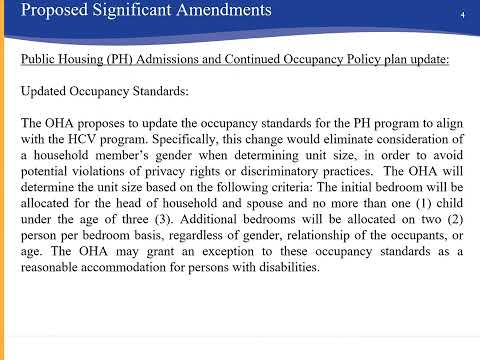
Lopez also proposed updating public housing occupancy standards to align with the HCV program, removing household members’ gender as a factor in determining unit size. She described the proposed rule as allocating the initial bedroom to the head of household and spouse, allowing no more than one child under age 3 in the initial bedroom, and assigning additional bedrooms at a two‑person‑per‑bedroom rate regardless of gender or age, with exceptions available as reasonable accommodations for persons with disabilities. “This change would eliminate consideration of a household member’s gender when determining unit size in order to avoid potential violations of privacy rights or any discriminatory practices,” she said.
Lopez summarized planned program activities contained in the 5‑year plan: OHA’s FY2024 Choice Neighborhoods Planning Grant ($500,000) to support a neighborhood transformation plan for La Colonia and central Oxnard neighborhoods including OHA‑owned properties; pursuing project‑based vouchers (PBVs) up to program caps; and activities related to RAD conversion, noting the board previously authorized a RAD application that HUD later approved.
On capital funding, Lopez described the capital fund program’s purpose and planned uses for FY2026. The transcript records the requested FY2026 capital fund budget as "a million57," which is unclear in the record; Lopez identified approximately $900,000 for capital improvements including furnace replacements at scattered sites (Project 317), rebuilding eight public housing units at Alia Court, and administrative expenses. The transcript does not provide a clear numeric total for the requested budget.
Lopez said HUD requires a 45‑day public comment period; staff opened the 45‑day period on December 4, 2025, and held public meetings on December 1, 2025, and January 8, 2026. She reported there were no written objections and that staff received seven verbal comments during the meetings.
Staff recommended that the Oxnard Housing Authority Board of Commissioners (1) hold the public hearing on the second year of the 5‑year PHA plan, the capital fund 5‑year action plan and the 2026 capital fund budget, and (2) adopt a resolution approving the 5‑year PHA plan and the 2026 annual PHA plan, authorizing the chair to execute HUD certification forms and authorizing the housing director to submit documents and accept and expend capital funds as indicated. The transcript records the recommendation but does not record a vote or a mover and seconder.
The presentation concluded with Lopez thanking the council. The transcript does not record further discussion or a board vote on the recommendations.