Get Full Government Meeting Transcripts, Videos, & Alerts Forever!
Get email alerts on the Psap Consolidation topic
No spam. Unsubscribe anytime.
Mission Critical consultant urges Enid and Garfield County to pursue collocation, shared services for 911
Summary
A Mission Critical Partners feasibility report recommends policy‑based shared services and collocation to reduce 911 call transfers, improve staffing and training, and enable grant applications; consultant Jenna Streer briefed Mayor and Board Commissioners and answered questions on costs and next steps.
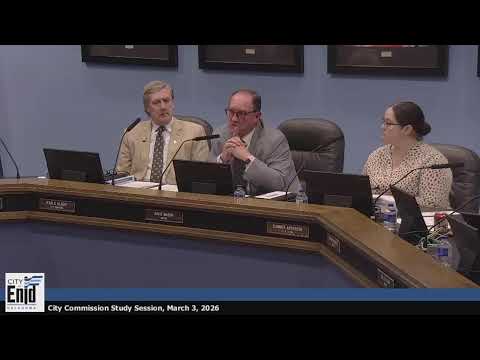
Mission Critical Partners consultant Jenna Streer told the Mayor and Board Commissioners at a study session that the firm’s eight‑month feasibility study recommends beginning with shared policies and collocation for the region’s public safety answering points (PSAPs), as a practical first step toward any broader consolidation.
Streer summarized the 80‑page report and said the analysis—based on Mission Critical’s MAPS assessment, on‑site visits, and virtual listening sessions with all four local PSAPs—found a collaborative baseline across Enid and Garfield County but few formal governance agreements such as memorandums of understanding. “We conducted an independent review of each agency to begin benchmarking the existing environment, highlight meaningful strengths, and also identify systemic challenges,” Streer said.
Why it matters: the study identifies routine call transfers between the city PSAP and two private EMS dispatch centers as a primary operational risk because transfers can delay life‑saving instructions on high‑acuity medical calls. Streer said Enid’s PSAP currently meets emergency medical dispatch (EMD) requirements and highlighted one clear operational strength: “EPD is answering 99.5% of their 911 calls in under 15 seconds,” she said, noting that commonly cited NENA benchmarks are 90% within 15 seconds and 95% within 20 seconds.
Key findings and recommendations: the report groups observations into nine lenses including governance, operations, staffing, training/QA, technology, alternative response, facilities and leadership. Notable findings included: - Transfers and caller experience: The city PSAP receives 911 calls that must be transferred to private EMS providers for medical call processing; Streer warned that transfers can lengthen time to instructions such as CPR and recommended reducing transfers through shared protocols and information flows. - Staffing risks: Several agencies operate with a single telecommunicator on duty for parts of the day. Mission Critical recommended reviewing authorized staffing to account for leave, breaks and surge events and urged multi‑year staffing plans; Streer illustrated that position‑based 24/7 coverage often requires roughly six staff per continuous seat. - Training and QA: The study found some strong training programs but inconsistent telecommunicator‑specific curricula and limited formal quality‑assurance programs. The report recommends formal QA, dispatcher‑focused training and mentoring to improve retention and professional development. - Technology: Radio systems show promising interoperability, but computer‑aided dispatch (CAD) and phone/CAD data sharing is limited. Streer recommended regional technology modernization and joint procurement to gain economies of scale. - Alternatives and admin calls: Enid’s non‑emergency/administrative call volume was reported at roughly three times the number of 911 calls; the study suggests options such as AI triage/handling for non‑emergency calls and alternative response models (behavioral health teams, community responders) to reduce dispatch workload. - Facilities and continuity: All PSAPs currently sit inside host‑agency buildings; some facilities may not meet hazard ratings for severe weather. The report recommends evaluating retrofit options or developing a collocated facility adapted for dispatch needs.
Recommendation summary: Mission Critical recommended starting with policy‑based shared services and pursuing collocation as a feasible near‑term step to reduce transfers and create redundancy; full legal consolidation is described as more complex and longer‑term, particularly given the presence of two private EMS agencies with their own interests.
Local reaction and next steps: Commissioners asked who should lead implementation and where funding would come from. Staff and the presenter said the feasibility study was a precondition for applying to state grant programs; Streer noted that building a collocated facility would likely cost millions and that formal cost‑sharing and governance agreements must be developed. Commissioners agreed to break the topic into follow‑up study sessions on staffing, technology and facilities and to pursue grant opportunities enabled by the study.
The study session adjourned and the board moved to reconvene for its regular meeting at the scheduled time.