Get Full Government Meeting Transcripts, Videos, & Alerts Forever!
Get email alerts on the Green Acres Disposal topic
No spam. Unsubscribe anytime.
Ridgewood council opens public hearing to clear decades-old Green Acres disposal, proposes replacement land and payments
Summary
At a Dec. 9 public hearing, Ridgewood officials described an after‑the‑fact disposal of a Broad Street playground discovered in 2011, presented replacement parcels and a compensation package to restore Green Acres funding eligibility and heard resident support and process concerns.
Ridgewood council members and staff on Dec. 9 held a public hearing on an after‑the‑fact disposal of parkland at South Broad Street and outlined a remediation package of replacement land, park improvements and a payment to the Garden State Preservation Trust intended to restore the village’s eligibility for New Jersey Green Acres grants.
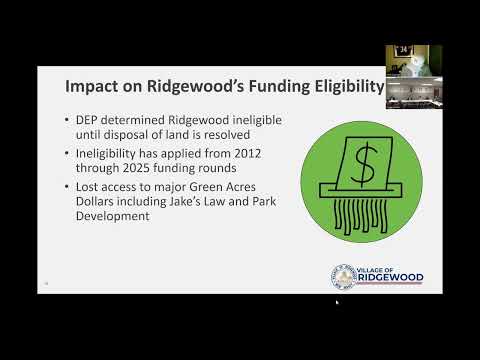
The presentation, led by Council member Sean and Council member Frank with consultant Chris Collie of Topology, explained that the disposal — originally a neighborhood playground removed in the early 1980s and discovered as a disposal event during a 2011 inventory — left Ridgewood ineligible for certain state parks and land grants. "This is an after‑the‑act major disposal of parkland," Collie said, describing the matter as a past disposal that must be remedied to regain funding eligibility.
Why it matters: presenters said Ridgewood has missed significant Green Acres opportunities since the ineligibility began, estimating a mid‑range loss of about $17.5 million over 13 years and noting a more aggressive estimate could reach $24 million. Officials highlighted Jake’s Law — a New Jersey initiative that can provide a 75% match for fully inclusive playgrounds, often worth $500,000–$750,000 per project — among the kinds of funding the village could seek once eligibility is restored.
What the village proposed: Collie summarized the compensation package required under Green Acres rules. Replacement land must meet a minimum 2:1 area ratio and have equivalent value, or the village must make a payment to close any value gap. The disposed parcel appraised at $750,000; the two replacement parcels appraised at a combined $436,000, creating a value gap that triggers payment. Collie also described replacement of recreation facilities (playground equipment and a pavilion) at King’s Pond and other stewardship improvements as part of the package.
Officials provided specific cost figures for the immediate remediation work presented to the council: an inclusive playground estimated at about $133,000; a new shelter about $92,000; and a line item described as a settlement cost around $314,000. Staff said Green Acres initially withheld more than $300,000, of which $200,000 was released last May and about $115,000 remains withheld pending completion of the disposal process.
Public comment: the council opened the hearing to residents and heard a mix of support and procedural concern. Rich Brooks, a Ridgewood resident and member of the Parks, Recreation and Conservation Board (speaking for himself), thanked staff and council for taking up the issue and said clearing the diversion would allow the village to pursue park projects it had been blocked from funding.
Resident Boyd A Loving objected to the location of replacement parcels and the outreach to nearby residents. "This looks like a done deal," Loving said, arguing the parcels proposed (Marlboro Road extension, King’s Pond playground improvements and Hammond Road) are not near the neighborhood that lost the Broad Street park and that many roads on the walking route lack sidewalks, making the replacement less accessible for neighborhood children. He also said residents near the replacement parcels had not received the same mail notice as those near South Broad Street.
Collie and other council members responded with process details: Heather described the prior posting of a sign at the South Broad Street property, certified mailings to residents within 200 feet, legal ads in the Ridgewood News, an online notice and a public comment period for written submissions; Collie said staff and some council members had also done neighborhood outreach in earlier years but that property prices and other constraints limited in‑town purchase options. Collie told a resident asking about tree replacement that historic aerials showed no trees were removed by the original conversion, so a tree‑replacement requirement did not apply.
Procedure and next steps: the public hearing was formally opened and, after in‑person and hybrid comments, a council member moved to close the hearing; the motion was seconded and the roll call recorded "Yes" votes from members present with Councilmember Whites absent. Officials said written comment would remain open for a period following the hearing (as earlier noted by staff) and described the next steps: submitting the final application package to Green Acres (part two), awaiting state commission consideration and delivering compensation and land conveyances that would add replacement parcels to the village’s protected open space inventory.
Council members and staff publicly thanked consultant Chris Collie and Topology for helping to shepherd the application process, and several residents also voiced support for regaining access to state funds and for the ecological benefits of additional protected land. The council concluded the hearing and signaled it would proceed with the remediation steps required by Green Acres.
What remains uncertain: the transcript and presentation list appraisals and estimated remediation costs, but the final payment amount to the Garden State Preservation Trust and the precise schedule for state approval were not specified in the hearing record. Written comments remain open per the notices provided by staff.