Get Full Government Meeting Transcripts, Videos, & Alerts Forever!
Get email alerts on the Code Enforcement topic
No spam. Unsubscribe anytime.
West Palm Beach special magistrate grants compliance windows, assesses fines and approves lien reductions after daylong code-enforcement hearing
Summary
At a Jan. 20, 2026 West Palm Beach code-enforcement hearing the special magistrate issued compliance deadlines, assessed fines for repeat violations, and approved negotiated reductions on several longstanding liens; a contested case over alleged targeting and a tree-screw citation drew extended argument.
West Palm Beach’s code-enforcement special magistrate reviewed dozens of property and business cases Jan. 20, 2026, issuing compliance deadlines, daily fines and several negotiated reductions of long-standing liens.
The hearing began with the magistrate explaining that the city presents evidence first, respondents may cross-examine and offer exhibits, and testimony is taken under oath. The magistrate repeatedly admitted city photos and officer testimony into evidence and then issued findings of fact and orders for compliance or fines.
In case C25114419 (2029 Wear Drive), Code Enforcement Officer Joseph Leerna said the property had been in repeat violation for 36 days for an inoperative vehicle (34-102B). Owner Huing Win acknowledged the property was now in compliance but asked for leniency. The magistrate found a repeat violation and assessed a fine of $20 per day for 36 days, totaling $720.
Several cases involving permit work, fencing and historic-property variances were continued to give owners time to pursue permits. For 231 Linton Court (C25114373), architect Walter Hyde said he planned to submit materials to the Historic Preservation Board and asked for 120 days; the magistrate granted the 120-day extension rather than imposing daily fines.
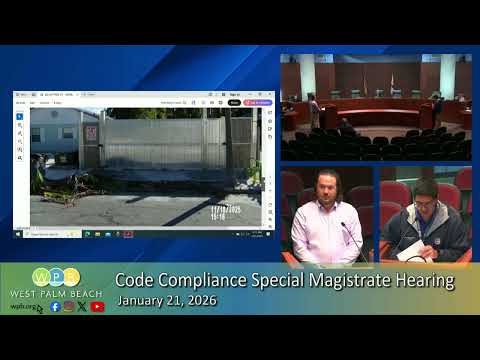
A notably contested case, C25114357 (236 Winona Place), involved multiple alleged violations including excessive vegetation, an unpermitted entrance gate and a tree-abuse citation for screws placed into a palm trunk. Respondent David Durren challenged portions of the city’s file, submitted exhibits from public records and alleged he had been targeted by a former West Palm Beach zoning employee now with Palm Beach County. Durren told the magistrate he had “six small screws in a palm tree to attach a security camera” and argued the code’s language concerns staking or nails, not small screws. The city’s officer, Richard Pasmino, said his inspection observed screws and other issues and testified that similar items had been brought before hearings by other officers. The magistrate said his authority was limited to whether the code was violated; he declined to adjudicate personnel complaints against city or county staff and ordered the respondent to remove the screws within 60 days and to obtain any required permits for fences, and gave 120 days for the fence-permit compliance, with fines possible thereafter.
Multiple vacant-building and public-safety cases were treated as higher priority: where officers documented conditions that could harbor vermin, attract trespassers or risk public safety (including an active wasp nest cited in case C25114354), the magistrate ordered short compliance windows—some as short as 10 days—and in several matters authorized the city to abate and assess abatement costs to the property if owners failed to act.
The hearing’s latter portion included so‑called “other matters” in which the parties reported negotiated settlements for accumulated fines and liens. The magistrate recorded several reductions of longstanding liens and fines in exchange for lump-sum payments by set deadlines (examples recorded in the minutes included reduced amounts and conditions that an unpaid settlement would revert to the original amount).
The magistrate closed the hearing after ruling on the remaining items and setting deadlines or abatement authority where needed. Many respondents were given 30–120 days to comply depending on permit requirements, public-safety risk and whether the city acknowledged progress toward compliance.
What happens next: the magistrate will issue written orders that will be mailed to respondents and recorded in the city file. Where abatement or lien-reduction actions were authorized, the city will follow up administratively if respondents do not meet the deadlines ordered today.