Get Full Government Meeting Transcripts, Videos, & Alerts Forever!
Get email alerts on the Public Safety Police Accountability topic
No spam. Unsubscribe anytime.
Pima County delays ordinance restricting masked, unidentified law-enforcement agents after heated public hearing
Summary
After hours of opposing and supporting testimony, the Pima County Board of Supervisors voted unanimously to continue Ordinance 2026-2 to March 23 so county attorneys can revise it based on public input; speakers on both sides raised public-safety and legal-preemption concerns.
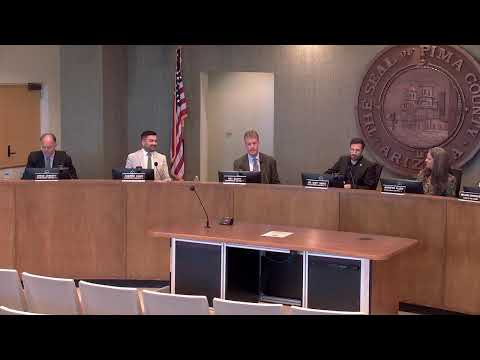
PIMA COUNTY, Ariz. — The Pima County Board of Supervisors on March 3 heard more than three hours of public testimony on Ordinance 2026-2, a proposed change to county code aimed at restricting unidentified people acting in law-enforcement roles from wearing masks or otherwise obscuring their identity. After extended debate the board voted 5–0 to continue the measure to its March 23 meeting and directed county attorneys to revise the draft in light of public comment.
The ordinance, introduced as an anti-impersonation and public-safety measure, would require officers or individuals performing law-enforcement functions on county property to display agency identification and a unique identifier and would limit mask-based concealment except in narrowly defined circumstances. Chair Jennifer Allen said the item "serves to protect law enforcement officers and the community from the very real danger of impostors who are going forward as though they are law enforcement." "I feel the urgency around addressing this issue but I also feel the importance of getting it right," she added.
Supporters told the board that unidentified, masked agents — and unmarked vehicles used in some arrests — intimidate immigrant and other communities and suppress reporting of crimes such as domestic violence. "We the people are organizing to preserve what is left of our constitution and democracy," said Margot Ituli of a local coalition, urging a strong ordinance and further measures (surveillance limits, redress mechanisms) so that residents who are fearful will still call for help.
Several speakers, including members of local immigrant-rights and community-protection groups, asked the board to end practices they said have harmed families. "We are seeing ICE carry out massive raids in our neighborhoods, hunting down our family members, our friends, our co-workers," said Tanya Nunes, who identified herself as a daughter of immigrants.
Opponents raised questions about legal preemption and practical enforceability. A long-serving law-enforcement speaker noted the U.S. Constitution's supremacy clause and argued the county could not regulate federal officers, and warned that broad prohibitions could endanger local officers who sometimes must wear masks for operational or safety reasons. "You are endangering our local law enforcement who need to wear masks in certain situations," the officer told supervisors.
County Attorney staff said the draft was prepared to balance local authority with constitutional limits. Senior counsel Michael Brown told the board, "We created the draft that we thought was most defensible by law and carried out what appeared to be the desire of the chair for putting this item on." He urged the board to accept public input so attorneys could refine language; supervisors voted to do exactly that.
Supervisor D3, who sponsored the ordinance, said a stronger, narrower ban on masking should be considered. Several board members asked the county attorney to examine model language used elsewhere and the ACLU Arizona recommendations that community groups referenced.
The board's action was procedural: it did not adopt the ordinance but instructed county attorneys to return with a legally defensible revision that incorporates public feedback and to present the revised ordinance for final vote at the March 23 meeting. The motion to continue passed unanimously.
What happens next: County attorneys will revise the draft ordinance and return to the board March 23 with amendments intended to address legal concerns and clarify exemptions and enforcement. Community groups on both sides said they will continue to provide input to the county as the text is rewritten.