Get Full Government Meeting Transcripts, Videos, & Alerts Forever!
Get email alerts on the Ice Training Whistleblower topic
No spam. Unsubscribe anytime.
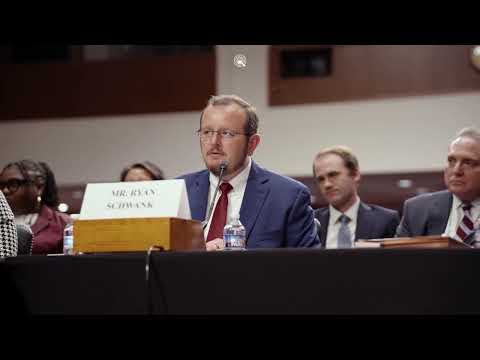
Former ICE assistant chief counsel Ryan Schwank says ICE Academy trains cadets to violate Constitution
Summary
Ryan Schwank, who resigned from ICE on Feb. 13, 2026, testified that ICE shortened its Academy curriculum and showed him a memo instructing cadets to enter homes without judicial warrants; he said the cuts removed 240 hours from a 584-hour program and risk unlawful arrests and deaths.
Ryan Schwank, who said he joined U.S. Immigration and Customs Enforcement as an assistant chief counsel on Aug. 1, 2021 and resigned on Feb. 13, 2026, told committee members that the ICE Academy’s training program has been shortened and changed in ways that, he said, teach cadets to violate the Constitution.
Schwank said he volunteered to teach law to new cadets at the ICE Academy in Gleno, Georgia and that, on his first day, he "received secretive orders to teach new cadets to violate the Constitution by entering homes without a judicial warrant." He said instructors were shown a memo that asserted officers could enter homes without a warrant and that supervisors indicated disobedience could cost an instructor their job.
"For the last five months, I watched ICE dismantle the training program, cutting 240 hours of vital classes from a 584-hour program," Schwank said. He listed removed instruction that he called essential: classes on the Constitution, the legal system, firearms training, use-of-force law, lawful arrests, detention and the limits of officer authority.
Schwank said ICE also "ceased all of the legal instructions regarding use of force," leaving cadets without formal training on the "objectively reasonable" standard courts apply when assessing deadly force. He described reductions to academic and practical testing that formerly let instructors verify whether trainees could safely and lawfully perform split-second duties.
He criticized Department of Homeland Security leadership for a push to produce "thousands of new officers before the end of the year," and said DHS publicly assures the public that graduates receive any missing instruction "on the job," a claim he called "a lie." Schwank said some graduates go to their home office only long enough to get equipment before being deployed, including to operations such as in Minneapolis, with what he described as minimal supervision.
Schwank explicitly referenced required standards, saying the cuts undermine regulations "such as HCFR287G1," and he contrasted a memo shown to him with DHS’s own 2025 legal training materials and the Fourth Amendment. He told the committee that deficient training, in his view, "can and will get people killed" and will produce unlawful arrests and violations of constitutional rights.
Schwank said many faculty share his concerns and concluded by telling the committee he was grateful for the opportunity to speak and was available to answer questions; a committee member replied, "Thank you, Mr. Schwank." The transcript supplied to the newsroom does not record further committee questioning or a named response in this session.
This testimony is a claim by a former ICE official alleging programmatic and policy failures; the committee record in the supplied transcript does not include a response from ICE or DHS in this session and does not establish the allegations as adjudicated facts.