Get Full Government Meeting Transcripts, Videos, & Alerts Forever!
Get email alerts on the Ccdbg Oversight topic
No spam. Unsubscribe anytime.
House Education Committee advances eight bills aimed at tightening CCDBG oversight amid partisan dispute
Summary
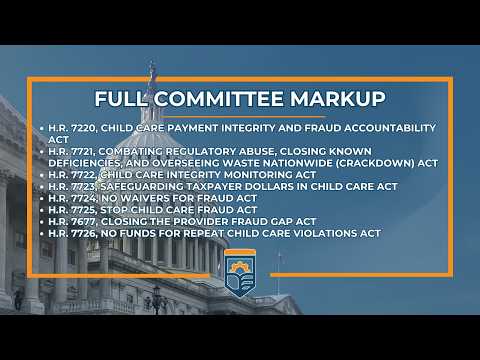
The House Committee on Education and the Workforce on May 14 advanced eight bills to strengthen oversight and fraud controls for the Child Care and Development Block Grant, reporting each to the House with amendments after heated debate on whether the changes will curb fraud or hurt access for families.
The House Committee on Education and the Workforce on May 14 advanced eight bills aimed at bolstering oversight and fraud prevention within the Child Care and Development Block Grant (CCDBG) program, voting to report each measure to the full House with amendments after several hours of debate.
The measures considered included HR7720 (the Child Care Payment Integrity and Fraud Accountability Act), HR7721 (an improper‑payment threshold bill), HR7722 (the Child Care Integrity Monitoring Act), HR7723 (safeguarding taxpayer dollars in child care by expanding debarment authority), HR7724 (No Waivers for Fraud Act), HR7725 (Stop Child Care Fraud Act), HR7677 (a GAO study on fraud prevention), and HR7726 (No Funds for Repeat Child Care Violations). Committee members completed roll-call votes on each bill and directed staff to transmit the amended bills and accompanying materials to the House.
Why it matters: Republicans framed the package as a bipartisan effort to protect taxpayer dollars and restore public trust after recent fraud findings in Minnesota. Supporters said more rigorous reporting, monitoring and debarment authority will deter repeat offenders and improve stewardship of federal funds. Opponents warned the bills risk imposing new administrative burdens on states and providers, diverting limited CCDBG dollars to compliance rather than service delivery, and potentially cutting off families if states face automatic sanctions.
How the committee voted: The committee report and final motions to report each bill were adopted. Recorded tallies recorded in the markup included multiple votes of 19–15 and 20–15 on various bills; two GAO/staffing–focused measures (including HR7725 and HR7677) passed overwhelmingly in recorded votes that recorded 35–0 in the transcript. (The committee chair announced votes, and several roll‑call tallies were read into the record.)
Key exchanges: Democrats repeatedly urged the committee to summon the Secretary of Health and Human Services, described in debate as the official responsible for CCDBG implementation, to explain recent HHS actions (including staffing reductions and a temporary freeze of federal funds to certain states) and to defend the department’s “defend‑the‑spend” payment management policies. Republicans pressed for stricter reporting categories, a lower improper‑payment threshold, reciprocal debarment with nutrition programs and elimination of waiver authority for sanctions.
What’s next: The committee directed staff to transmit the amended bills to the House. Those bills will be scheduled for floor consideration at a later date, where each will face House procedures and potential amendment. Several members asked for additional oversight hearings and GAO reports to inform future policymaking.
Votes at a glance: The committee record readouts in the markup show final reported motions passed for HR7720, HR7721, HR7722, HR7723, HR7724, HR7725, HR7677 and HR7726; recorded tallies in the transcript varied by bill (examples: HR7720 reported 19–15; HR7722 reported 20–15; HR7725 reported 35–0; HR7677 reported 35–0; HR7726 reported 20–15). The committee authorized staff to make technical and conforming changes to the bills prior to transmission to the House.
The markup concluded with the chair adjourning the committee and allowing members to submit additional materials for the record.