Get Full Government Meeting Transcripts, Videos, & Alerts Forever!
Get email alerts on the Public Health Regulation topic
No spam. Unsubscribe anytime.
Cerritos planning commission recommends ban on recreational nitrous oxide sales, with limited exceptions
Summary
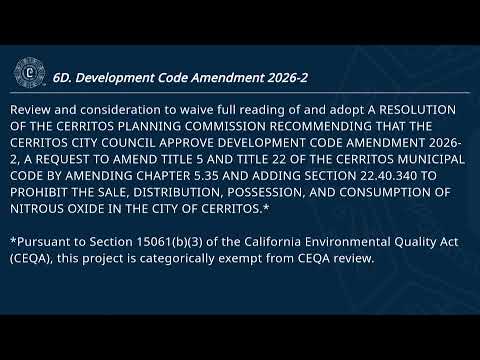
On a 5‑0 vote March 4, the Cerritos planning commission recommended that the City Council approve Development Code Amendment 2026‑2 to prohibit sale, distribution, possession and consumption of nitrous oxide for recreational use while exempting medical, dental, culinary and industrial uses; the item will go to council March 23, 2026.
The Cerritos City Planning Commission voted unanimously March 4 to recommend that the City Council adopt Development Code Amendment 2026‑2, which would amend Titles 5 and 22 of the Cerritos Municipal Code to prohibit the sale, distribution, possession and recreational consumption of nitrous oxide within city limits while preserving legitimate medical, dental, culinary, wholesale and certain industrial uses.
Management analyst Mariel Angelus presented the proposal and described the motivation: increased recreational misuse of nitrous oxide and related public‑health and environmental concerns. Angelus cited California Penal Code section 381B (which criminalizes possession of nitrous oxide with intent to inhale for intoxication) and noted state bills under consideration that would further restrict retail access. She said the proposed local amendment would include exemptions when nitrous oxide is contained in a food product as a propellant, when distributed wholesale, for authorized medical and dental uses under licensed practitioners or wholesalers licensed by the State Board of Pharmacy, and other circumstances exempted by state law.
Commissioners questioned enforcement, incidence data and the reach of a consumption prohibition. Staff said the Cerritos Sheriff’s Station reported no specific nitrous‑oxide emergency incidents to date and that enforcement could include administrative proceedings, code‑enforcement remedies or criminal prosecution coordinated with the city attorney as appropriate. Some commissioners raised constitutional and practicality concerns about regulating private consumption versus commercial sale; staff replied that the proposed local code aligns with existing state law that restricts possession and inhalation for intoxication and that the amendment focuses on commercial sale and distribution.
Staff recommended the commission wave full reading and adopt a resolution recommending City Council approval. The commission approved the recommendation 5‑0. If the council approves the amendment on March 23, 2026 and adopts it after second reading, staff said implementation would begin May 13, 2026. The staff report invited council consideration of the ordinance and noted similar local ordinances in other cities.