Get Full Government Meeting Transcripts, Videos, & Alerts Forever!
Get email alerts on the Public Comment topic
No spam. Unsubscribe anytime.
Residents urge Broomfield council to prepare for federal immigration operations and to stop lethal prairie-dog control during breeding season
Summary
Public commenters asked council to direct staff to draft an immigration emergency response plan outlining notification protocols and to place an immediate moratorium on lethal prairie-dog control during March–April breeding season pending policy updates; staff did not take immediate action at the meeting.
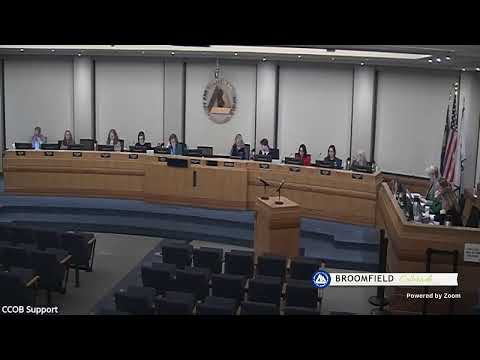
Two in-person public comments at the March 3 meeting asked the council to take preemptive local steps on separate community concerns.
Bria Shecker of Willow Park (Ward One) told the council she was attending her first meeting to urge a formal immigration emergency response plan. Citing what she described as recent university data showing a large increase in ICE operations, Shecker asked staff to prepare a plan that would: (1) provide transparency protocols so the city would notify residents if federal enforcement activity occurred in Broomfield; (2) reaffirm that city resources and personnel will not be used to assist civil immigration enforcement; and (3) ensure continuity of services so schools, clinics and local transit remain safe and operational during federal operations.
Shecker asked the council to direct staff to prepare that plan rather than rely solely on equity statements. Council acknowledged the concern; no formal direction to staff was recorded in the meeting minutes.
Caller Robin Sinclair (Willow Run) raised a separate matter about Broomfield’s prairie-dog-control policy. Sinclair said prairie dogs were exterminated on March 3 during the breeding season (March–April), asserted the city spent $12,370 on prairie-dog extermination in March 2025, and urged an immediate moratorium on lethal control during breeding season, plus written buffer-zone guidance and staff training on nonlethal methods. Sinclair said residents opposed to lethal control were not being heard and asked the council to act sooner than the fall 2026 OSAC review staff had indicated.
Council did not vote or direct staff to take immediate action on either request; both items were raised during the public-comment period for council consideration.
Speakers thanked the public for commenting and council members acknowledged the concerns while noting staff processes for policy review and interagency coordination.