Get Full Government Meeting Transcripts, Videos, & Alerts Forever!
Get email alerts on the Supplemental Budget topic
No spam. Unsubscribe anytime.
Joint transportation committee hears LD 2213 supplemental highway-fund allocations, agency witnesses outline staffing and modernization items
Summary
At a public hearing on LD 2213, agency witnesses described highway-fund-neutral staffing reclassifications, new positions tied to the Extreme Risk Protection Order Act, a sexual-assault kit tracking initiative, and BMV modernization carryover language (including a mistaken elections provision the Secretary asked to strike). A union urged restoring cut DOT positions and closing the state pay gap.
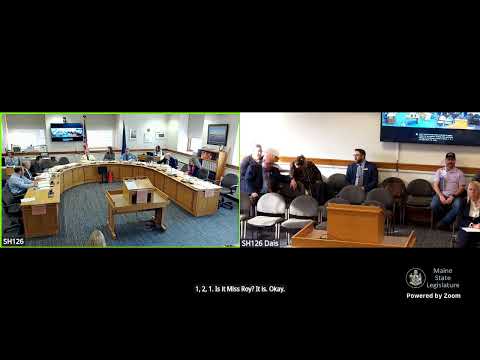
Representative Lydia Crafts opened a joint public hearing of the Legislature's Joint Standing Committee on Transportation on LD 2213, the supplemental budget bill that proposes highway-fund and related allocations for fiscal years 2026 and 2027.
The administration's witnesses said most initiatives in the package are reclassifications and internal transfers rather than new ongoing positions, and that several measures are expressly highway-fund neutral. "The proposal delivers financial relief to Maine people, preserves programs lawmakers and Maine people support, and addresses some emergent issues," Department of Public Safety Commissioner Mike Suck said in presenting his agency's portion of the bill.
Suck outlined multiple Maine State Police staffing adjustments and reclassifications, funding for barracks relocation in Ellsworth and related rent increases, and initiatives to support implementation of the state's Extreme Risk Protection Order Act. He said one initiative would add a corporal, a lieutenant and three specialist positions and provide funding for five hybrid police-interceptor vehicles to carry out the act's duties, which the commissioner noted went into effect Feb. 22, 2026. He also described an initiative to fund two forensic positions, a mobile unit and a contracted trainer to establish a statewide sexual-assault forensic-examination-kit tracking system tied to LD 1816.
Committee members questioned several details during the Department of Public Safety's presentation. Representative Krabs flagged a numeric discrepancy in language part F: the committee's document lists $304,164 while the commissioner testified to $320,614; the commissioner confirmed his testimony cited $320,614. Members also pressed for more detail on the barracks rent increase; Suck said the department's current annual rent for the Northern Field Troop is about $35,000 and that Bureau of General Services staff estimate a market-rate facility would cost about $105,000 annually.
Secretary of State Shenna Bellows testified for the Bureau of Motor Vehicles (BMV) items in the bill, describing nine approved personnel reclassifications and a carryover provision to continue a multi-year modernization effort. Bellows said the BMV is carrying forward modular modernization work that has already linked the license system to other states, will launch a new license system in June, and expects to begin electronic titling and an integrated registration system in subsequent phases. She said the bill includes a carryover provision to allow up to $2.5 million in unexpended balances to be carried forward to complete those modernization steps.
Bellows told the committee that one carryover language paragraph referencing elections had been included in error in the highway-fund bill and asked the committee to strike that part (part D). "We are not proposing that you use any highway funding for elections. That would be unconstitutional. So we ask that you strike that language but not the other carryover," she said.
Members asked Bellows for timeline and oversight details; she said modernization work is done with colocated contract programmers funded through carryover and that the agency can provide implementation and audit details at the work session.
Maine Department of Transportation Commissioner Dale Dowy described the DOT portion of the supplemental as largely highway-fund neutral, driven by reclassifications and position transfers to align work with program funding. Dowy also alerted the committee to a late revenue-forecast update showing weaker highway-fund receipts: he said highway-fund revenue was projected to be down roughly $14 million in the current biennium and about $15.88 million in the next biennium, which could require mitigation steps. Dowy said the bill contains a language item (part E) that would make explicit the committee's jurisdiction over highway-fund financial orders and allow the committee to waive the 30-day pre-submission requirement to the Office of Fiscal and Program Review in time-sensitive or emergency situations.
At the public-comment portion, Mark Bruntton, president of Maine Service Employees Association Local 1989, said the union supports many reorganizations but criticized LD 2213 for failing to restore 60 transportation jobs eliminated in the last biennial highway budget and for not closing the state employee pay gap. "This raid on the salary plan in 2025 wasn't a one-time occurrence," Bruntton said, urging lawmakers to use available surplus to restore personal services funding and to address consultant-overuse and pay disparities.
The public hearing was closed and the chair asked for a motion to "agree with language." A member moved and called for a vote, but the transcript ends before a tally or final disposition is recorded.
What happens next: the departments and committee members repeatedly said line-by-line details and any needed adjustments will be worked through in the scheduled work sessions. Agencies offered to supply supporting documentation and timelines (for example, Bellows said the BMV could provide modernization progress reports and an itemized account of how carryover funds were used).