Get Full Government Meeting Transcripts, Videos, & Alerts Forever!
Get email alerts on the Emergency Communications Pace Planning topic
No spam. Unsubscribe anytime.
CISA webinar outlines PACE planning to keep emergency communications running when systems fail
Summary
Bob Connors of CISAs Emergency Communications Division walked through PACE (Primary, Alternate, Contingency, Emergency) planning, common failure modes, reporting best practices and priority services such as GETS, Wireless Priority Service and TSP; slides and a follow-up webinar will be shared.
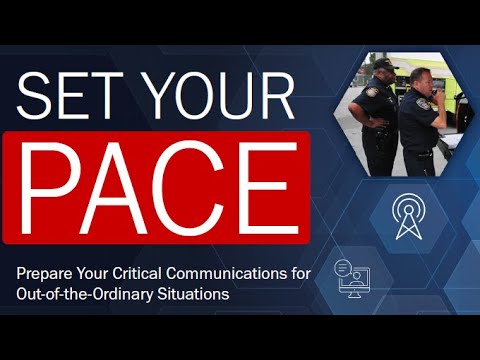
Bob Connors, a functional manager in the Cybersecurity and Infrastructure Security Agencys Emergency Communications Division, led a public webinar on PACE planning, a four-tier methodology intended to preserve mission-critical communications when primary systems fail. Connors defined PACE as primary, alternate, contingency and emergency methods and said the goal is predictable, resilient communications across agencies and sectors.
PACE planning, Connors said, requires input from both technical staff and operational users so plans match real-world needs. "Who do you and your organizations need to communicate with, and what type of mission-critical information do you need to send and receive?" he asked, urging attendees to identify critical information requirements and to rank what is essential versus what is merely desirable.
Using practical examples, Connors explained trade-offs at each PACE level: an alternate channel often uses the same technology with reduced capability (for example, switching radio frequencies), contingency solutions use a different subsystem (for example, cell phones or satellite phones), and emergency methods are last-resort options such as sending a runner or traveling to a command post. He warned that moving to a lower PACE level can remove capabilities and may take personnel out of service.
The presentation reviewed common causes of communications failure that organizations should plan for, including user error, power outages, radio-frequency interference, network congestion or outages, and cyber incidents. Connors emphasized timely incident reporting: end users should notify help desks or IT with detailed symptoms and timestamps so technical teams can diagnose root causes rather than rely on partial fixes.
Connors also described three priority services meant to increase call-completion chances during congestion. He said the Government Emergency Telecommunications Service (GETS) gives landline priority and completes about 98% of calls in congestion scenarios; Wireless Priority Service provides cellular priority with roughly a 95% completion rate; and Telecommunications Service Priority (TSP) gives prioritized circuit installation and restoration by service providers when pre-registered. He cautioned that none of these services can overcome physical infrastructure damage (for example, severed lines or downed towers).
To make priority dialing easier, Connors demonstrated a free dialer app that stores GETS/WPS access numbers and PINs; the app simplifies placing a priority call but does not replace the need to register for the underlying services. He announced a follow-up webinar focused on GETS and TSP and said registration links and the slide deck would be posted in chat and on agency feeds. Connors added that the webinar recording and slides will be made available afterward.
On planning practice, Connors recommended simple, repeatable briefings and periodic exercises with interoperability partners, both public and private. He contrasted incident-level radio plans such as ICS-205 (Incident Radio Communications Plan) with PACEs higher-level strategy: ICS-205 documents frequencies and talk groups for a specific incident period, whereas a PACE plan documents fallback pathways and triggers across primary, alternate, contingency and emergency levels.
The webinar closed with an offer to answer follow-up questions via the Emergency Communications Division email (ECD at dhs.gov) and a note that attendees would receive the slide deck and a link to the recorded session. A colleague thanked Connors and closed the session.