Get Full Government Meeting Transcripts, Videos, & Alerts Forever!
Get email alerts on the Land Use And Planning topic
No spam. Unsubscribe anytime.
Planners warn 'downzoning' provision in Disaster Recovery Act creates legal uncertainty as county advances flood, zoning updates
Summary
County planning staff and legal counsel warned that a downzoning clause in the North Carolina Disaster Recovery Act — which staff say requires written consent from affected property owners — is ambiguous and could increase litigation risk, so staff will prioritize standalone ordinances (flood, stormwater, subdivision) while pausing certain zoning-ordinance changes.
Buncombe County planners told commissioners the county's implementation timetable for elements of its comprehensive plan has been reconfigured after storm recovery work and because of legal uncertainty created by a downzoning provision that was added to the North Carolina Disaster Recovery Act.
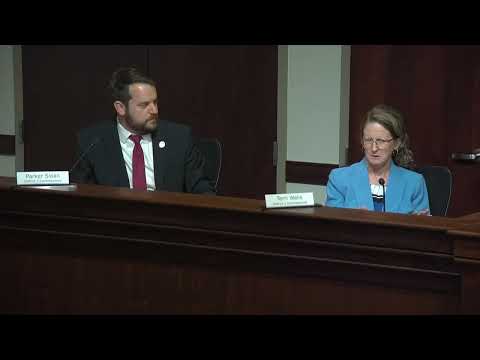
Planner Nate Pennington and colleague Jillian Phillips said the county shifted to prioritize recovery and life-safety measures after the destructive storm referred to in the briefing as "Helen," focusing first on environmental and public-safety ordinances such as flood, stormwater, erosion control and E911 addressing. Pennington said staff have a targeted flood-ordinance amendment ready for planning-board review and stressed that standalone ordinances (those not contained in the zoning ordinance) are safer to pursue while the legal picture is unsettled.
The concern centers on a provision in the Disaster Recovery Act staff described as a "downzoning" requirement. Staff said the provision appears to require written consent from each property owner affected by a zoning action that reduces development density, but that the law's language and its boundaries are unclear. "What that could mean is a whole lot of us not knowing a lot of what it means," Pennington said, warning that the definition of what constitutes downzoning or a new nonconformity is murky.
A county legal advisor (introduced during the briefing as Kurt) told the board that chapter 160D — the state statute governing planning and zoning — is generally protective of vested rights and that this newly inserted downzoning provision adds another layer of ambiguity, increasing litigation risk for some zoning changes. "Any zoning change may or may not be challenged," the legal advisor said, and he urged caution when considering extensive changes to ordinance standards that could be characterized as downzoning.
Staff pointed to one recent text amendment as an example of implementation work the county has completed: a dimensional-table amendment in the Beaverdam zoning district that ended mandatory single-family zoning there and modernized standards; staff said the change was supported by the comprehensive plan's growth, equity and conservation policies.
Jillian Phillips outlined the calendar for work that will proceed: the flood ordinance is scheduled for a planning-board public hearing in March and for the county board's public hearing in April; E911 addressing modernization will be introduced to the planning board in April with hearings at planning board and county levels later in the summer; the Swannanoa small area plan draft is expected in July with public outreach in August and adoption targeted for September 2026.
Staff said they will continue internal work on many text amendments and ordinances that do not appear to trigger the downzoning risk and will be prepared to resume broader zoning-ordinance changes if and when the statute or case law provides clearer guidance.
Sources: Presentations and remarks by Nate Pennington and Jillian Phillips (planning staff) and remarks by a county legal advisor identified as Kurt during the briefing.