Get Full Government Meeting Transcripts, Videos, & Alerts Forever!
Get email alerts on the Water And Sewer topic
No spam. Unsubscribe anytime.
Freeport council hears $77 million Bulldog Road plant plan and fast-track SRF timetable
Summary
City staff and financial advisers presented the proposed Bulldog Road wastewater treatment plant — a 1 MGD facility expandable to 3 MGD — with a current estimate of roughly $77 million and a funding gap near $50 million. Consultants urged council to approve a rate structure and related resolutions in August to apply for State Revolving Fund (SRF) financing in September.
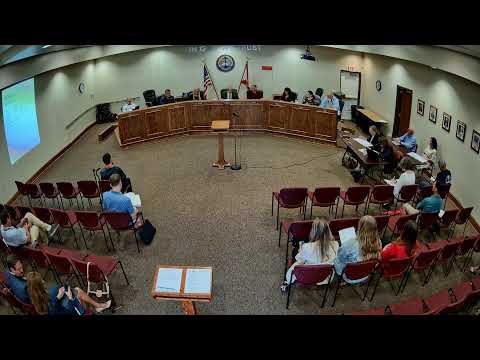
City of Freeport officials and outside advisers told the council on Aug. 12 that design for the proposed Bulldog Road wastewater treatment plant is about 95% complete and construction could run from 2026 through 2028.
The project was scoped as a 1 million‑gallon‑per‑day treatment plant that can be expanded to 3 MGD; advisers cited an estimated project cost of about $77 million and said the city currently has roughly $27 million available from cash on hand, ARPA and capacity fees, leaving an approximate $50 million funding gap.
“We modeled a package that assumes about $27 million up front,” Jeremy, the city’s financial adviser from PFM, told the council. “SRF loans today are in that 2.75–3% range for a 20‑year structure; that’s materially cheaper than market alternatives, so getting an SRF application in the next window is extremely valuable.”
Consultants said the city must approve a new sewer rate structure, hold the required public meeting and pass resolutions this month to submit an SRF application in September and pursue the November funding round. If the city misses that cycle, the next SRF opportunity would be February. “In order to hit the November meeting… we have to have an approved rate structure this month,” Alex, the engineering lead, said.
Advisers outlined fallback options if SRF capacity is limited: the federal WHIPA program (longer terms but higher indicative debt costs currently), private bank loans or bond anticipation notes as interim financing, and a potential mix of SRF for part of the need plus opportunistic bank financing for the remainder. They warned that some funding choices can preclude other low‑cost options (for example, accepting certain types of interim debt can limit USDA eligibility for some future projects).
Council members pressed staff on timing, the trade‑offs of borrowing now versus waiting for subsidized loans and how to structure any multi‑source financing so the city preserves access to lower‑cost programs. Jeremy said the consultants would return with a plan that lays out SRF capacity, estimated rates under different financing mixes, and the recommended issuance approach.
Next steps on the schedule presented to the council include: a public meeting on the draft rate structure, council adoption of resolutions and the capital financing plan this month if the council wishes to pursue SRF, and, if approved, an SRF application submission in September for consideration in November.