Get Full Government Meeting Transcripts, Videos, & Alerts Forever!
Get email alerts on the Judicial Process topic
No spam. Unsubscribe anytime.
Supreme Court of Texas justices tell Rio Grande Valley students how they weigh statutes, hypotheticals and the Constitution
Summary
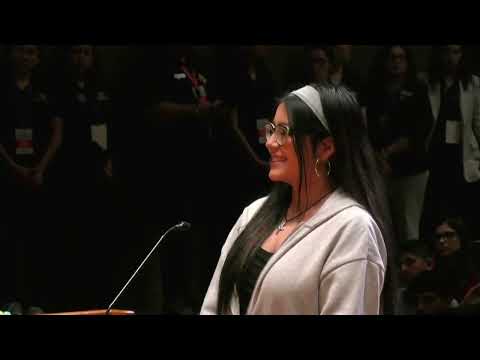
At a University of Texas Rio Grande Valley student Q&A, members of the Supreme Court of Texas described how written briefs, statutory text and hypothetical questions guide their decisions and encouraged students considering law careers.
At a student Q&A at the University of Texas Rio Grande Valley, members of the Supreme Court of Texas explained how they balance statutory text, constitutional principles and hypothetical questions when deciding cases and offered practical advice to students interested in legal careers.
Justices told students that the court relies heavily on written briefs and the statutory language before them during oral argument. "We have written briefs that you guys can see online on the website that educate us about the arguments that are going to be made," said Justice Bland, noting that several justices keep statutory text and notes at hand and evaluate attorneys' answers against state law.
The bench also described why hypotheticals are a regular feature of oral argument. "When we ask those hypothetical questions, we're getting at . . . whether or not this case . . . is going to substantially and significantly affect the jurisprudence of the state of Texas," Justice Lairman said, adding that hypotheticals help the court anticipate how an opinion might play out in future but not identical cases and avoid unintended results.
Justice Young gave an extended explanation of constitutional interpretation and history, telling students the Texas Constitution took effect in 1876 and has been amended frequently. He said the original document was "roughly 22,000 words" and, after recent amendments, now runs about "110,000 words," and noted that 17 amendments were approved in November of the previous year. "Whatever those words meant to the people who adopted it, they must mean the same thing today," Young said, emphasizing that judges determine what the people's law is and do not have authority to change it.
The court also responded to a student question about establishing a law school at UTRGV. An unnamed student identified as the vice president of the student body said a student senate had passed a bill supporting a law school in the Rio Grande Valley. The Chief Justice said the court "oversees the legal profession and the regulation of the legal profession which . . . includes law schools" and described a new law school as "an undertaking for sure" that would require significant effort and resources. He added that the Valley is the state's fifth-largest metropolitan area and said he saw no reason not to pursue such a goal.
Justices closed by offering career advice to students. "Talk to all of the people you can who are in a position you would like to see yourself in," Justice Huddle said, and recommended reading the Constitution and court opinions, getting out of one's comfort zone to seek mentors, and reflecting on whether the work and commitment required fit the student's goals.
No formal court actions or votes were taken during the session; justices held the event as an educational outreach while hearing argument in the court's regular docket.