Get Full Government Meeting Transcripts, Videos, & Alerts Forever!
Get email alerts on the Tax Relief Rte topic
No spam. Unsubscribe anytime.
Task force asks for sensitivity analysis after survey finds RTE benefits may flow to higher‑income households
Summary
At a Feb. 26 meeting the Tax Relief Evaluation Task Force reviewed survey results and modeling of the Residential Tax Exemption (RTE), debated how much relief goes to higher‑income property owners, and asked staff to run sensitivity scenarios and produce a clearer integrated report and slide deck for the Select Board.
The Tax Relief Evaluation Task Force met Feb. 26 to examine new survey results and modeling of the Residential Tax Exemption (RTE) and to weigh options the Select Board could consider to reduce perceived inefficiencies in the program.
Ellen, who led the presentation of the survey and data, said the team received 94 survey responses — 861 homeowners and 43 renters in the dataset used for analysis — and cautioned the group that the results are self‑reported and use range categories rather than exact incomes. "So, we had 94 responses," Ellen said, noting caveats about mapping ranges to income breakpoints for the town’s analysis.
Rich, who summarized the study’s insights, told the group the findings are clear enough to shape recommendations: "There is strong support for the RTE but it's much weaker among those who are not getting the RTE," he said, urging the task force to present options rather than a single prescription.
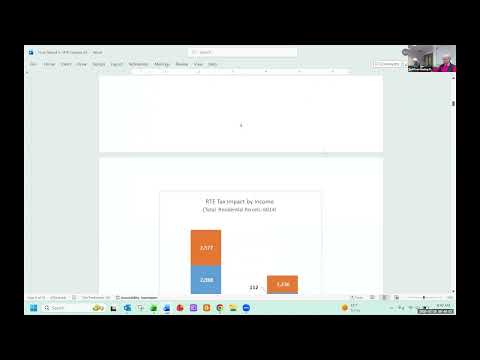
Members focused on how the team translates survey responses into townwide impacts. Presenters identified roughly 1,600 parcels that fall below an illustrative "break even" threshold yet did not qualify for RTE; depending on how those parcels’ incomes are characterized, the share of RTE benefits going to higher‑income households varies substantially. The group asked staff to run "book‑end" sensitivity scenarios that show best‑ and worst‑case assumptions so readers and Select Board members can see how results change under different assumptions.
The task force discussed four broad responses to the distributional concerns: phasing out the RTE entirely, lowering the exemption percentage, expanding targeted senior relief programs (including means‑tested senior exemptions), and increasing public education and targeted outreach to increase qualified participation. The group also discussed adopting M.G.L. c. 41C½ (often called "41C and a half"), which requires Town Meeting and a townwide vote but could extend senior relief to more households using circuit‑breaker style income limits.
Participants noted consequences attached to each path. Several members warned against removing the RTE without a clear replacement because doing so could raise taxes for existing beneficiaries — particularly seniors — before any new program is in place. The group recommended sequencing or pilot approaches, such as targeted landlord outreach, a small pilot for renter‑related relief, and a public education campaign to increase eligible take‑up.
On next steps the task force agreed John will produce sensitivity charts and scenarios and the team will assemble an integrated report and a plain‑English slide deck intended for the Select Board and public meetings. The draft integrated report is expected ahead of the task force’s next meeting; members also proposed a Select Board placeholder in April to ensure the board sees the analysis before town meeting season.
The task force approved the minutes from Feb. 19 at the start of the Feb. 26 meeting and adjourned after finishing the discussion and agreeing on deliverables.
What’s next: staff will run sensitivity analyses on the 1,600 parcels, prepare an integrated draft and slide deck, and return to the task force with revised charts and clear explanatory text ahead of the next meeting.