Get Full Government Meeting Transcripts, Videos, & Alerts Forever!
Get email alerts on the Worker Misclassification topic
No spam. Unsubscribe anytime.
Minn. committee hears testimony that worker misclassification costs billions; advocates urge stronger enforcement
Summary
Lawmakers heard unified testimony that worker misclassification—labeling employees as contractors—harms workers, undercuts law-abiding employers and costs Minnesota billions; witnesses urged stronger interagency enforcement, project-owner accountability, unannounced site checks and a January 2027 state study to fill data gaps.
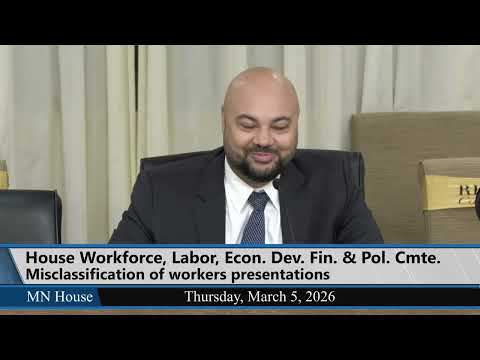
Saint Paul — Lawmakers on the Minnesota House Workforce, Labor, Economic Development, Finance and Policy Committee heard multi-hour testimony that employers who label employees as independent contractors are shifting costs to workers and taxpayers and creating a competitive advantage for bad actors.
Rep. Dave Pinto, chair of the committee, opened the hearing and said members would hear presentations from the Attorney General’s Office, labor unions, employers, researchers and state agencies about the mechanics, scope and enforcement challenges tied to worker misclassification.
Leah, an assistant attorney general and manager in the office’s wage enforcement unit, told the committee that misclassification “rips off workers and taxpayers” because employers avoid paying minimum wage, overtime, payroll taxes, unemployment insurance and workers’ compensation. She cited existing studies that estimate Minnesota workers lost between $2.9 billion and $6.2 billion in compensation (2019 base estimate) and said the state could be losing as much as $0.5–$1.3 billion in tax and premium revenue, while stressing that precise statewide totals remain uncertain pending the ongoing state study.
Union and employer witnesses described how the fraud commonly works in practice. Kevin premise, speaking for a construction laborers’ organization, described crews in multiple trades who are paid off the books or issued 1099s despite working under supervision and on projects that resemble typical W‑2 employment. “This is fraud,” he said, calling it “tax fraud, unemployment insurance fraud” that disadvantages law-abiding firms.
Matt Waller, operations manager at Braxton and Sons Framing and Trim, told lawmakers that companies using a misclassification model can realize an immediate labor-cost advantage “of 30% or more,” and that his firm has lost projects and laid off carpenters as a result. Waller urged stepped-up enforcement and more frequent, unannounced site visits to verify payroll compliance.
Jesse Madison, a payroll and event-staffing business owner, gave venue-level examples — including a large arena booking where he said hundreds of thousands in properly billed payroll were avoided — and recommended pre-event venue checkpoints requiring proof of workers’ compensation and unemployment coverage before work begins.
Speakers from the Minnesota Nurses Association and the Minnesota AFL–CIO described similar patterns in health care and platform-based staffing, warning that app-driven shift-assignment systems sometimes misclassify nurses and can undermine patient safety and collective-bargaining protections.
Research testimony likewise emphasized both scale and uncertainty. Erin Rosenthal of Northstar Policy Action summarized a September 2024 analysis that estimated nearly 10% of Minnesota’s private‑sector workforce (roughly 300,000 workers in 2019) experienced misclassification, and that workers lost $2.9–$6.2 billion in 2019 (which Rosenthal said would inflate to higher dollar figures today). Panelists and members repeatedly noted limits to current measures — audits and payroll comparisons can miss off‑the‑books cash work and employers who classify all workers as independent contractors.
State agencies described work underway. Karen Rats of the Attorney General’s Office reviewed a 2023–24 task force that led to 2024 legislation creating an Intergovernmental Misclassification Enforcement Partnership and a private right of action for misclassified workers. Agency researchers detailed a contracted study — using tax, unemployment-insurance and survey methods plus qualitative interviews — with a final report due January 2027. Department of Labor and Industry staff reported rising intake contacts (from under 100 in calendar year 2023 to roughly 343 in 2025) and described a mix of informal education, wage‑claim resolutions (about $46,000 recovered across certain claims), and resource‑intensive investigations.
Committee members pressed on data precision, differences between the share of audited employers versus share of employees misclassified, how investigators can follow repeat offenders (including possible restrictions on government contracting), and whether enforcement or new statutory tests would be most effective. Members emphasized interagency data sharing, targeting high‑risk industries and exploring responsible‑contractor frameworks to stop serial cheaters.
Next steps: agencies are continuing the interagency study due January 2027, and the committee previewed future hearings on unemployment insurance assessments and other workforce issues.
(Reporting here is based solely on testimony and materials presented at the committee hearing.)