Get Full Government Meeting Transcripts, Videos, & Alerts Forever!
Get email alerts on the Budget General Fund topic
No spam. Unsubscribe anytime.
Cumberland mayor opens FY2026 general-fund hearing, centers budget on school construction as superintendents warn of cuts
Summary
At a May 27 public hearing on Ordinance 25-10, the mayor said the FY2026 budget is driven by planned school construction and proposed a 3.5% tax rate (4% levy); Superintendent Dr. Thornton and School Committee Vice Chair Carrie Smith warned per-pupil spending lags state averages and said continued reliance on fund balance risks job cuts. No vote was taken.
The Cumberland Town Council on May 27 opened a public hearing on Ordinance 25-10, the town’s proposed FY2025–26 general fund operating budget, with the mayor framing school construction as the budget’s central driver and proposing a 3.5% tax rate and a 4% levy. The council did not vote on the ordinance that night.
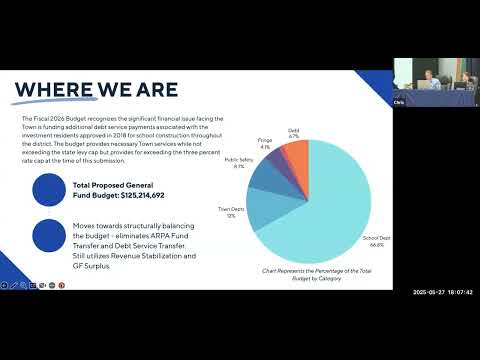
"Our main funding focus is going to be the school construction," the Mayor said, describing a budget balanced in part with $350,000 of fund balance and roughly $700,000 in revenue stabilization. The mayor told the council that the proposed package also accounts for an approximately $740,000 town contribution to education, rising police pension/OPEB costs, trash and recycling increases, growing debt service and a roughly $200,000 need for IT hardware replacement. He said a recent property revaluation means the proposed rate will likely change by assessment, but the levy is modeled at 4%.
Superintendent Dr. Thornton said Cumberland’s per-pupil spending has fallen further behind the state average and that the district has relied on fund balance to stay afloat. "In 2020 the average cost of a student in Rhode Island was $18,438. In Cumberland we're at $15,214. Fast forward to 2023, the average cost of a child is $23,357. We're at $17,451," Dr. Thornton said, adding that the district used $2.2 million in fund balance in FY25 and has roughly $1.2 million already baked into next year’s budget. He warned those choices mean the district will eventually need to reduce positions: "a time will come very soon where fund balance will no longer be an option and this P.E. problem will rear its head."
Carrie Smith, vice chair of the school committee, urged the council to consider the district’s request for larger increases. Smith said the committee had sought an additional 2.2% from the town and that the mayor’s proposal yielded about a 1.35% increase for schools; she highlighted rising enrollment in multi-learner language programs and the potential harm of deferred technology and staff reductions. "Chromebooks are very important… a grade is going to be impacted," Smith said.
Council members read the proposed totals into the record: total mayor-proposed revenue and general fund totals reported as $125,214,692 and the mayor-proposed school department total recorded as $83,685,749. The mayor and staff confirmed a school construction (housing) aid amount used for modeling as $3,921,721 and said that amount is expected to increase in FY27.
Councilors pressed the mayor on how master leases and debt service are reflected, and the mayor explained some $5 million master leases will be moved out of departmental operating budgets into capital or master-lease lines and repaid from capital fund adjustments over the next three years. He said gross school debt service (about $6 million) is shown separately and that housing aid is applied on the revenue side; that mix constrains options for exceeding the statutory levy.
The public hearing closed at 6:55 p.m.; no in-person or virtual public speakers were recorded. The council scheduled a finance subcommittee meeting May 29, a second public hearing June 2 and a final vote on June 4 at 7:30 p.m. at Cumberland Town Hall.
Why it matters: Cumberland’s FY26 proposal ties near-term operating choices to an expensive school construction program and to reimbursement assumptions from state housing aid. School leaders say current per-pupil funding and continued reliance on one-time fund balance pose risks to staff and services, setting up a policy tension the council will have to reconcile in June.