Get Full Government Meeting Transcripts, Videos, & Alerts Forever!
Get email alerts on the Homelessness topic
No spam. Unsubscribe anytime.
Island County outlines five-year homeless housing plan, urges more emergency shelter and flexible eviction-prevention funds
Summary
Island County Human Services presented a draft five-year homeless housing plan calling for strengthened coordinated entry, more emergency shelter options (including transitional pallet homes), increased flexible eviction-prevention funding and provider wage supports; a public hearing is tentatively scheduled for mid-April.
Emily Wildman, Island County's housing program manager, presented the county's draft five-year homeless housing plan to the Oak Harbor Police Community Advisory Board, saying the plan is required by the state and is meant to align with local comprehensive-plan housing elements. Wildman described five objectives intended to guide county and city action over the next five years: re-engage coordinated entry and improve reporting; strengthen the homeless service workforce and establish local case-management standards; prevent episodes of homelessness through more flexible eviction-prevention funding and client supports; prioritize assistance for people at greatest risk (including emergency shelter plans for extreme weather); and expand housing options through zoning changes and targeted land searches.
The plan emphasizes using existing resources and achievable goals rather than assuming new funding will arrive. Wildman said the county distributed a lived-experience survey to people experiencing homelessness to identify barriers and gaps and that the Washington State Department of Commerce provides guidance and reporting tools the county must follow. She described the county's coordinated entry as the primary access point for services and noted alternative "side doors" for veterans, domestic-violence survivors and young adults. Wildman also urged stronger partnerships with smaller "by/for" organizations that serve populations less likely to access county offices.
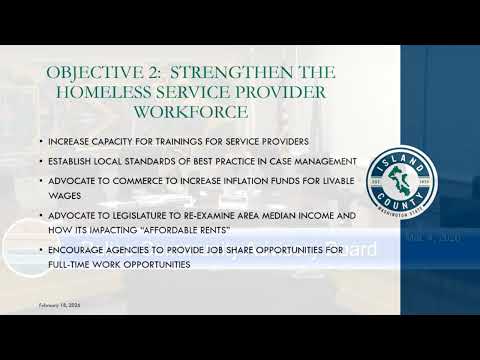
On workforce issues, Wildman recommended annual training, local standards of best practice for case management and advocating for targeted inflation funds that allow agencies to raise wages without diverting service dollars. She said federal metrics such as area median income (AMI) can make some units technically "affordable" while still unaffordable for many residents, and that voucher levels must reflect local rents to be effective.
Wildman provided data on recent trends: coordinated-entry intakes rose from about 780 in 2019 to over 900 in 2025, and the Haven night-by-night shelter has seen its senior population increase from roughly 35 in 2019 to about 63—68 in 2025 (Wildman referred to the draft and said updated charts are available). She said the task force favored achievable, locally driven actions such as increasing flexible funding, improving case-management skills (financial literacy and debt assistance), and seeking land for higher-density affordable housing. Wildman suggested transitional options such as pallet homes as a middle step between emergency shelter and permanent housing, noting the need to identify both appropriate sites and organizations to operate any new shelters.
Board members questioned specific numbers and demographic trends; Wildman said an updated draft with charts would be circulated and noted the plan must be presented to the Island County Board of Commissioners and to municipal councils before a public hearing (she said a public hearing was tentatively scheduled for mid-April). Wildman also said the county must report annually to the Washington State Department of Commerce on progress and proposed edits.
The presentation spurred discussion about complementary policy options — local living-wage ordinances, rent caps, and expanding coordinated-entry access in Oak Harbor rather than requiring residents to travel to Coupeville — with Wildman advising that each option has political and implementation trade-offs. She recommended addressing wage policy and voucher levels together where possible and said outreach presence in Oak Harbor had increased through an outreach case manager and the county's north office, though no permanent coordinated-entry relocation was pledged.
The board asked for distribution of the updated draft and data charts; Wildman said she would circulate the materials and that the draft appears on the county website.