Get Full Government Meeting Transcripts, Videos, & Alerts Forever!
Get email alerts on the Gender Equality Access To Justice topic
No spam. Unsubscribe anytime.
UN Women urges member states at CSW70 to make access to justice a priority
Summary
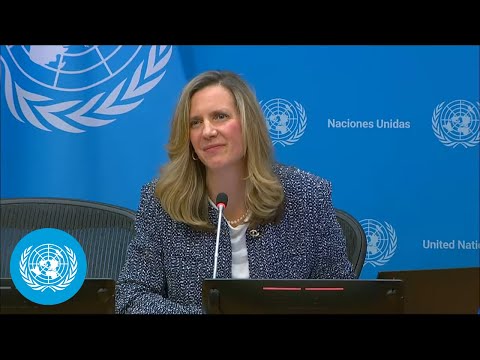
At a press briefing ahead of the Commission on the Status of Women, UN Women representative Sarah Hendris said legal gaps, impunity and shrinking civic space are eroding gains for women and girls and urged member states to legislate, fund and coordinate justice reforms.
New York — Sarah Hendris, a representative of UN Women, told reporters at a Commission on the Status of Women briefing that access to justice is central to achieving gender equality and that member states must act now to reverse ‘‘organized push back’’ against women’s rights.
"No country in the world right now has yet achieved full legal equality between men and women," Hendris said, summarizing findings set out in the Secretary‑General’s report being discussed at CSW70. She warned that discriminatory laws, weak enforcement and shrinking civic space, compounded by conflict and economic strain, leave large numbers of women and girls without meaningful protection.
Hendris cited several statistics from the report to illustrate the scope of the problem: in roughly three‑quarters of countries laws still allow child marriage; in 44% of countries the law does not mandate equal pay for work of equal value; and family‑law reforms since 1970 have opened new economic opportunities for an estimated 600 million women. She also said reporting on sexual violence is often deterred by fear of retaliation, stigma or economic loss.
The UN Women representative outlined six priorities for reform she said are central to the Secretary‑General’s recommendations: repeal discriminatory laws and close legal gaps; ensure justice actors and social services work together; adopt preventive and gender‑responsive measures; finance legal aid and survivor‑centered services; shape reform with women’s voices and movements; and make justice systems ready for the digital age while guarding against algorithmic or platform‑driven harms.
In a question‑and‑answer session, reporters pressed Hendris on how UN Women plans to build consensus among 193 member states and on country‑specific crises. When Edith Letterath of the Associated Press asked how UN Women will persuade all member states to reverse course, Hendris said negotiations on this year’s agreed conclusions were proceeding ‘‘in a constructive environment’’ but that final texts typically reflect a balance of member‑state views.
When asked by Ephraim Kosafi of Arab News Daily to name the countries where rights are most violated, Hendris declined to supply a ranked list but said the Secretary‑General’s report highlights that justice is especially constrained in conflict and crisis contexts and named examples including Sudan, Haiti, Afghanistan, Palestine/Gaza and Iran as places where women’s access to justice is severely limited.
Other questions addressed survivors’ needs and measurement. Nam Abdullah of Rudaw Media Network asked about barriers facing Yazidi survivors in Iraq and what metrics UN Women uses to track backsliding; Hendris said the report focuses on legal regression, civic‑space constraints and declines in financing for women’s organizations, and that those indicators, alongside legal changes, are part of how UN Women monitors the trend.
Reporters also raised sharply worded criticisms. Abdul Hamid Sam of the Arabic Daily Alabi asked whether UN Women had ‘‘miserably failed’’ women in Gaza; Hendris responded that UN Women has worked in Gaza and across Palestine for decades with women‑led organizations to deliver services, support resilience and press for dignity, justice and humanitarian access, and that those needs go beyond survival to include accountability and livelihoods.
On operational questions, Hendris described UN Women’s ‘‘triple mandate’’ of policy engagement, UN‑system coordination and on‑the‑ground programming across some 80 countries to support legal reform, protective services and economic inclusion.
Hendris ended by calling CSW70 a decision point: member states must decide whether to legislate for equality, finance implementation, and strengthen coordination so that justice reaches ‘‘the everyday lived realities of women and girls.’' The briefing closed with the moderator noting the Commission would reconvene the following day.
Sources: Remarks and exchanges at the UN Women CSW70 press briefing, as delivered by Sarah Hendris and reporters on the record.