Get Full Government Meeting Transcripts, Videos, & Alerts Forever!
Get email alerts on the Transportation topic
No spam. Unsubscribe anytime.
Road & Bridge outlines spring/summer work, raises pass-opening trade-offs and plans gate review
Summary
Road & Bridge Supervisor Ryan Regetti detailed equipment purchases, a large crushing program to support road rebuilding, a summer schedule of gravel and chip‑seal projects, and contingency plans for dust suppression — then joined commissioners in a lengthy debate over when to accelerate alpine pass openings and agreed to convene a gate‑policy review with the Forest Service.
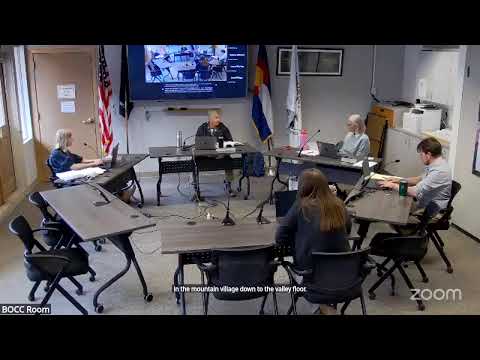
Ryan Regetti, San Miguel County road and bridge supervisor, presented the department’s spring/summer plan on Feb. 25, describing administrative prep, personnel training, equipment purchases and a planned large crushing program to produce material for multiple road repairs.
Regetti said the county expects to crush roughly 60,000 cubic yards of material across pits (including Pathfinder, Zadra and Beaver Park) to support reconstruction and surface replacement projects in coming seasons. The department plans asphalt patching, chip‑seal prep on specified road segments and targeted culvert replacements; specific roads named included Deep Creek Road (62L), Alder Creek (56V), County Road 63L resurfacing, and work in Beaver Park and Fall Creek to restore through routes.
On dust suppression, Regetti noted procurement of suppliers and an intent to start applications earlier if weather permits, but he emphasized the approach depends on water availability. He said dust-control applications require significant water for pre‑treat and penetration and that low river conditions could limit the number of applications the county can sustain. He described contingency steps including topping off county water storage and possible external water hauling if river calls restrict use.
Pass openings: The board discussed whether to push for earlier alpine pass clearings to support tourism and outfitters or delay openings to reduce equipment wear, cost, safety risk and neighborhood impacts. Regetti explained operational constraints — staffing, avalanche and debris risk, and the need for two-person teams in high‑country operations — and described the Forest Service’s role in soft‑roadbed recommendations and gate management. Residents and operators spoke from both sides: Oufir residents asked for slower openings to reduce traffic, noise and safety concerns; operators urged earlier access for economic reasons. Commissioners asked staff to convene a follow‑up meeting with road staff, Forest Service and local stakeholders to clarify gate policy and recommend an agreed approach.
Action taken: Commissioners requested staff to convene a technical gate‑policy meeting involving the U.S. Forest Service and community representatives and asked for a report back to the board by the end of March. No formal policy change or vote was taken during the session.
Ending: Commissioners thanked Regetti for the detailed work plan and agreed to publicize project dates as schedules firm up so residents can plan for closures and detours.