Get email alerts on the Utility Billing topic
No spam. Unsubscribe anytime.
Pinellas Park council adopts broad utility code changes after debate over master‑meter billing
Summary
The council unanimously passed Ordinance 4269 to move utility fees to ordinance, clarify billing practices and authorize a stormwater mitigation credit program. Mobile‑home park representatives warned master‑meter billing could raise costs for low‑income residents; staff said program details will return to council.
The Pinellas Park City Council on Aug. 8 unanimously adopted Ordinance 4269, a sweeping update to the city's utility code that moves fee-setting to ordinance, clarifies billing procedures for potable and reclaimed water and sanitary sewer service, and authorizes a stormwater mitigation credit program.
The ordinance, presented by Utility Billing Manager Don Von, aims to set fees and connection charges by ordinance rather than by resolution, simplify residential and nonresidential billing procedures, require active utility accounts for connected properties, and permit estimation of consumption in specified circumstances. Von told the council the changes are intended to "clarify and simplify Utility Billing procedures" and to create a mitigation credit program for stormwater fees.
The change drew extended questioning from councilmembers about how the rules will affect master‑metered mobile home parks and tenants. In response to council questions about meter removal and illegal reconnections, staff said property owners should be notified when a meter is pulled and that cost recovery for theft or illegal reconnection would often fall to the owner, though civil remedies may be needed.
Dylan Luke, a works supervisor who described the mitigation program, said the stormwater credit would provide financial incentives for on‑site stormwater management that reduces runoff. He said program details will be advertised and that the credit program itself will return to council for approval with engineering and application requirements, including an engineer's form, inspection and an online application through the building department.
Harold Myers, who identified himself as associated with Park Lawn mobile home park, told the council the proposed billing approach risks saddling low‑consumption residents with disproportionately higher per‑gallon charges. Myers said residents in his master‑metered park use about 1,250 gallons per month on average and estimated, with the proposed schedule, they could pay roughly 156% more per gallon and would lose individual meter protections against leaks. "These lower income residents in the community that are the most efficient users ... are going to be paying 150% per gallon of what a single family resident pays," Myers said, and urged clearer rate‑schedule language and protections for master‑metered communities.
Staff replied that master‑metered properties will be billed based on "available units" (the number of units served by the master meter) as a transitional billing method and that some developments already receive courtesy billing pending conversion to automatic meter infrastructure (AMI) and submeters. Von said some bills might increase while others decrease depending on prior arrangements, and that citywide consistency was a goal.
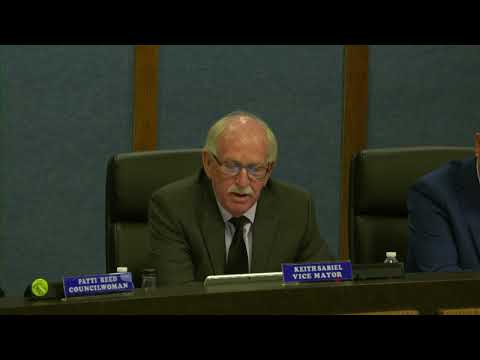
After the public comment and staff discussion, Vice Mayor moved and council seconded the motion to adopt Ordinance 4269 on second and final reading; the motion carried unanimously.
The ordinance also authorizes the city to establish a stormwater mitigation credit program; staff said the program's eligibility and application process will be returned to council for separate approval. The council also discussed outreach and notification for owners and tenants during billing transitions.
The council adjourned utility discussion by approving the ordinance; staff will provide the detailed mitigation program and rate exhibits for future council scrutiny.
AI generated
The text on this page is AI generated. Summaries, highlights, analysis, and video transcripts are all produced from the original source material.
AI can make mistakes, so if you spot one, and we will fix it for everyone.
Note: the source content is unaltered by us. Any content source we link to, be it a video, an audio recording, or a document, is presented exactly as its publisher released it. That publisher is usually a government body, sometimes an individual official or another organisation.