Get Full Government Meeting Transcripts, Videos, & Alerts Forever!
Get email alerts on the Education Health Literacy topic
No spam. Unsubscribe anytime.
Weill Cornell librarians, NNLM present IMLS‑funded high‑school health‑literacy curriculum
Summary
Weill Cornell librarians and NNLM Region 7 described CHAMP, a 2½‑week push‑in curriculum funded by an IMLS grant that teaches health‑literacy skills, source evaluation (SIFT), citation practice, and career pathways through a celebrity‑based performance task and publicly available toolkit under a Creative Commons license.
Weill Cornell Samuel J. Wood Library librarians and the National Network of the National Library of Medicine (NNLM) Region 7 on a public webinar presented the Community Health Ambassador Program (CHAMP), a 2½‑week push‑in curriculum that teaches high‑school students health‑literacy and library‑career skills. Sarah Levin‑Lederer, NNLM Region 7 outreach and education coordinator, said the toolkit and recording will be posted and emphasized that the National Library of Medicine maintains MedlinePlus, which presenters recommended as a first stop for fact‑checking medical information.
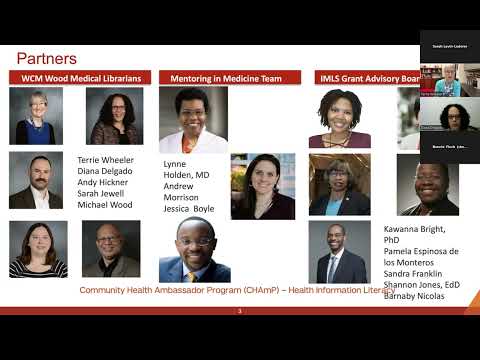
The curriculum was developed with partners including Mentoring in Medicine and delivered in anatomy classes at three partner schools. Presenters said the work was funded by a two‑year Institute for Museum and Library Services (IMLS) grant. Terrie Wheeler, director at the Samuel J. Wood Library, described a design cycle that used instructor scoring rubrics, pre/posttests, and student focus groups; teacher Jessica Boyle led a revision that reduced lecture time and increased small‑group, task‑based learning.
Presenters outlined five instructional modules: module zero (orientation and a 10‑question pre/post test), module one (finding credible information and MedlinePlus), module two (career introduction and Jigsaw activities), module three (evaluating claims using the SIFT method), module four (health‑literacy practice and misinformation exercises), and module five (citation practice and distinguishing scholarly vs. popular sources). The group performance task asked students to act as medical librarians hired by a celebrity to debunk misinformation; student teams were graded on a five‑domain rubric with a 20‑point maximum.
Michael Wood and Terrie Wheeler explained the SIFT method (Stop; Investigate the source; Find better coverage; Trace claims) and used diet‑related examples to show how students evaluate bias and evidence. Sarah Jewell said module four included practice questions to use with doctors, exercises to identify misinformation vs. disinformation, and a four‑corners activity for assessing social‑media posts. The team noted students most often relied on popular, patient‑facing resources (MedlinePlus, society sites), though some teams did locate PubMed records or indexed books.
Presenters read student reflections and short excerpts from final projects. One student, quoted by the presenters, cited the National Library of Medicine when discussing a substance and said it "can lead to seizures as well as fatality" and that "in a study, it led to death in a lot of people, like over 50%." Presenters did not provide an on‑webinar validation of that statistic; the webinar emphasized instructor vetting of sources and the SIFT evaluation process.
During Q&A the presenters addressed classroom logistics: the push‑in model was made possible through partnership with Mentoring in Medicine (which helps place instructors in classrooms), session length varies by school (45– or 90‑minute blocks), and the curriculum generally occupied about ten class sessions over two‑and‑a‑half weeks. Presenters reported they did not observe students using ChatGPT for the project in class (noting some district blocking and in‑class supervision), and they advised that individual modules can be taught standalone if access is limited.
The toolkit and a QR code were shared during the session; presenters confirmed a Creative Commons license requiring citation and asked users to credit the toolkit and include the project link. The team also described evaluation methods: independent focus‑group follow‑up by Mentoring in Medicine (audio‑recorded in year two) and the possibility of longitudinal tracking of student outcomes through Mentoring in Medicine rather than direct project follow‑up by the librarians.
Advisory board members praised the project for its adaptability and potential to spark teacher interest in librarianship. Presenters closed by thanking NNLM and IMLS, providing the evaluation link for continuing education credits, and inviting attendees to contact NNLM Region 7 for toolkit access and follow‑up.