Get Full Government Meeting Transcripts, Videos, & Alerts Forever!
Get email alerts on the War Powers topic
No spam. Unsubscribe anytime.
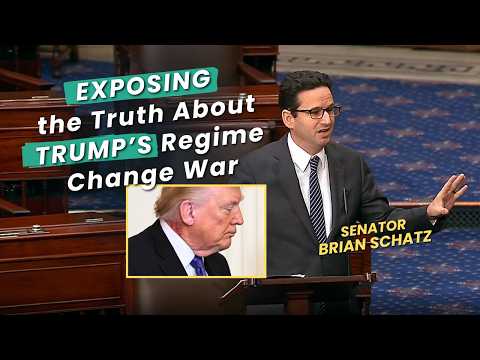
Mr. Schatz calls U.S. action in Iran "a war of choice," pledges support for Kaine War Powers resolution
Summary
Mr. Schatz told the Senate the administration provided no imminent-threat justification for action involving Iran, criticized the administration's planning and communications, and said he will support a War Powers resolution by Sen. Kaine to block further use of U.S. forces.
Mr. Schatz addressed the Senate floor, saying the recent U.S. military action involving Iran "is a war of choice" and arguing the administration offered no imminent-threat justification for using force. He said the decision followed the U.S. withdrawal from the Joint Comprehensive Plan of Action and reflected an administration willing to use kinetic force as a first option.
Mr. Schatz said, "This is a war of choice," and added, "There was no imminent threat from Iran." He criticized the administration's communications, saying officials had given conflicting accounts after the Venezuela operation and that the president's public comments had emphasized tangents such as ballroom renovations rather than explaining the rationale for military action.
He argued that the legal standard for a president to use force without prior congressional authorization requires an "imminent threat" — an immediate, credible attack on the United States — and disputed the administration's logic that a separate state's action (he cited Israel) could be translated into an imminent threat to U.S. interests. "There are no bank shots when we're describing an imminent threat," he said.
Mr. Schatz urged that if the country is to engage in military action absent such a threat, Congress must hold hearings, receive briefings and vote on an authorization of the use of military force. He said that without that process, the president's unilateral use of force undermines the public's role in significant foreign-policy decisions.
On the floor he said he will support a War Powers resolution introduced by Sen. Kaine and others that is intended to block the use of American forces in Iran. "I will support that, of course," he said of the Kaine resolution, and he repeated that if Congress does not act to constrain the use of force, it should at least require a public debate and a formal vote.
Mr. Schatz warned against pursuing another regime-change strategy, citing past U.S. interventions in Iraq, Libya and Vietnam as examples of long-term consequences. He closed by saying Congress has a duty to check a reckless president and to represent the will of the American people.
The speech did not record any formal motion or vote on the Senate floor; Mr. Schatz spoke in support of the pending War Powers resolution and called for congressional process before additional military commitments.